
SaaStr's Jason Lemkin once launched a feature to 275,000 users. It "worked perfectly in dev… and immediately crashed in production because we hadn't tested it with real data volumes" (SaaStr). Nothing exotic went wrong. The demo had just never seen real data.
This isn't an anti-AI story. The same team shipped three AI-assisted apps to production in 30 days (SaaStr), and it now has 12+ vibe-coded apps with 800,000+ total uses (SaaStr). Building the apps worked. Keeping them running was the hard part. Lemkin's estimate is that a production-ready app takes about a month of work, and 60% of that time goes to QA and testing (SaaStr).
A note on method: this is our reading of what founders have published. That means SaaStr's write-ups, threads on Product Hunt's vibecoding forum and one public security disclosure. It isn't a story about one of our clients. Below we group what breaks into five areas (the grouping and its order are ours), then cover what each fix costs, a pre-launch checklist and the signs that it's time to bring in an engineer.
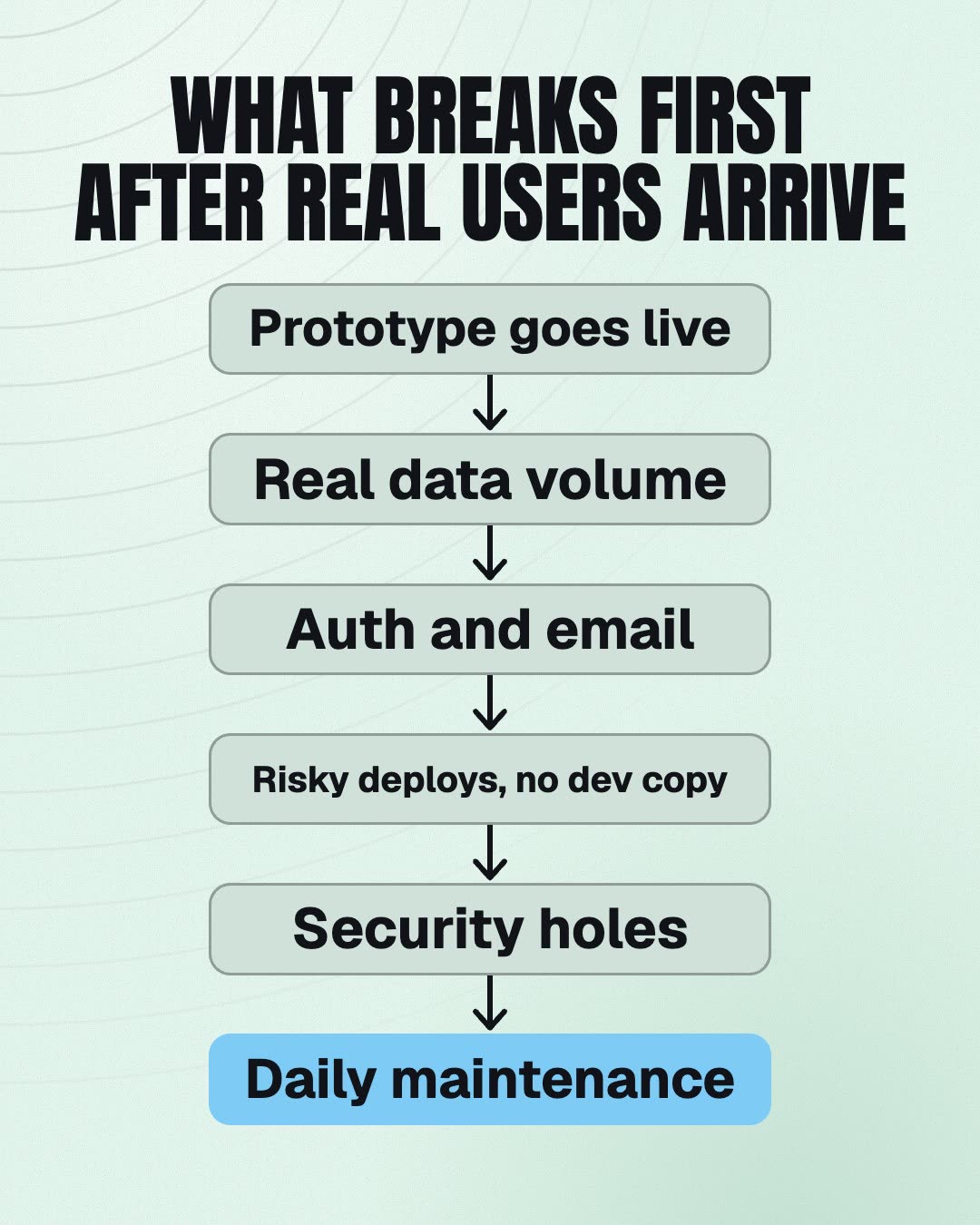
1. Real data volume: the demo had ten rows
The 275,000-user crash is the classic version. Your test data is tiny and tidy, and real users bring thousands of records, odd inputs and phones. Lemkin's advice is a testing checklist for every feature: the happy path, error cases, edge cases like empty states and special characters, mobile vs desktop, different user roles, and a load test with 100x the data.
Complexity is the other half of the problem. SaaStr's VC valuation calculator has over 5,000 inputs across 20 variables, which Lemkin calls "too much complexity to just 'vibe'". So he did the analysis in Claude first, validated the maths and gave Replit only the outputs: three simple tables. That left the builder with just the interface.
Even then, an agent-built calculation passed the basic tests but had a rounding error that skewed valuations for deals under $5M by exactly 37%. It took three weeks to catch, because it only showed up with very specific deal structures (SaaStr).
2. Auth and email: the parts that should be easy
SaaStr says every one of its five production apps struggles with email. Connections to SendGrid or Resend break, scheduled emails stop sending and API connections get lost. Login is the same story. The platforms' built-in authentication works well, but "the moment you try to use external OAuth (Google, LinkedIn, etc.), everything falls apart" (SaaStr).
On Product Hunt, founders were asked what broke first when they scaled, and auth came up a lot. One founder found that "any signed-in user could read every table" (Product Hunt). Login worked. Permissions didn't.
Then come regressions. In Lemkin's example, you ask the AI to improve the profile page and it does a great job. Then you find the login flow is broken or email notifications have stopped, because the agent changed a shared component that other parts of the app rely on.
- Use the built-in auth of your platform. Leave external OAuth until someone can review it.
- Add a daily health check: can users sign up, log in and complete the core action, do the APIs respond, are there database errors? SaaStr runs one every 6 hours, and it has caught production issues dozens of times before users saw them.
- Keep a regression list of flows that must always work. Lemkin spends 30 minutes after every significant change clicking through the whole app.
3. No deploy pipeline: testing on live users
The Replit agent deleted SaaStr's database of 1,206 executive records, despite explicit instructions not to make changes. Lemkin "had no fallback plan" and no manual backups. Replit first said the database couldn't be restored, then found that rollback did work after all (SaaStr).
Releases also come often. Lemkin pushed updates to SaaStr.ai 22 times in 17 days, and every push is a chance to break something live. Mona Kohlhaas built a SaaS called Xolora with Emergent. Once it needed a more complex architecture, "Vercel deployments and GitHub conflicts became a nightmare", and Mona later rebuilt it with a professional developer (Product Hunt).
Here's the release flow Lemkin uses now:
- Make changes in a separate dev copy, ideally with its own database.
- Test thoroughly in dev.
- Check for regressions in dev.
- Deploy to production.
- Monitor production for 24 hours.
We'd add two things: backups stored somewhere the agent can't reach, and knowing how your platform's rollback works before you need it.
4. Security: you inherit all of it
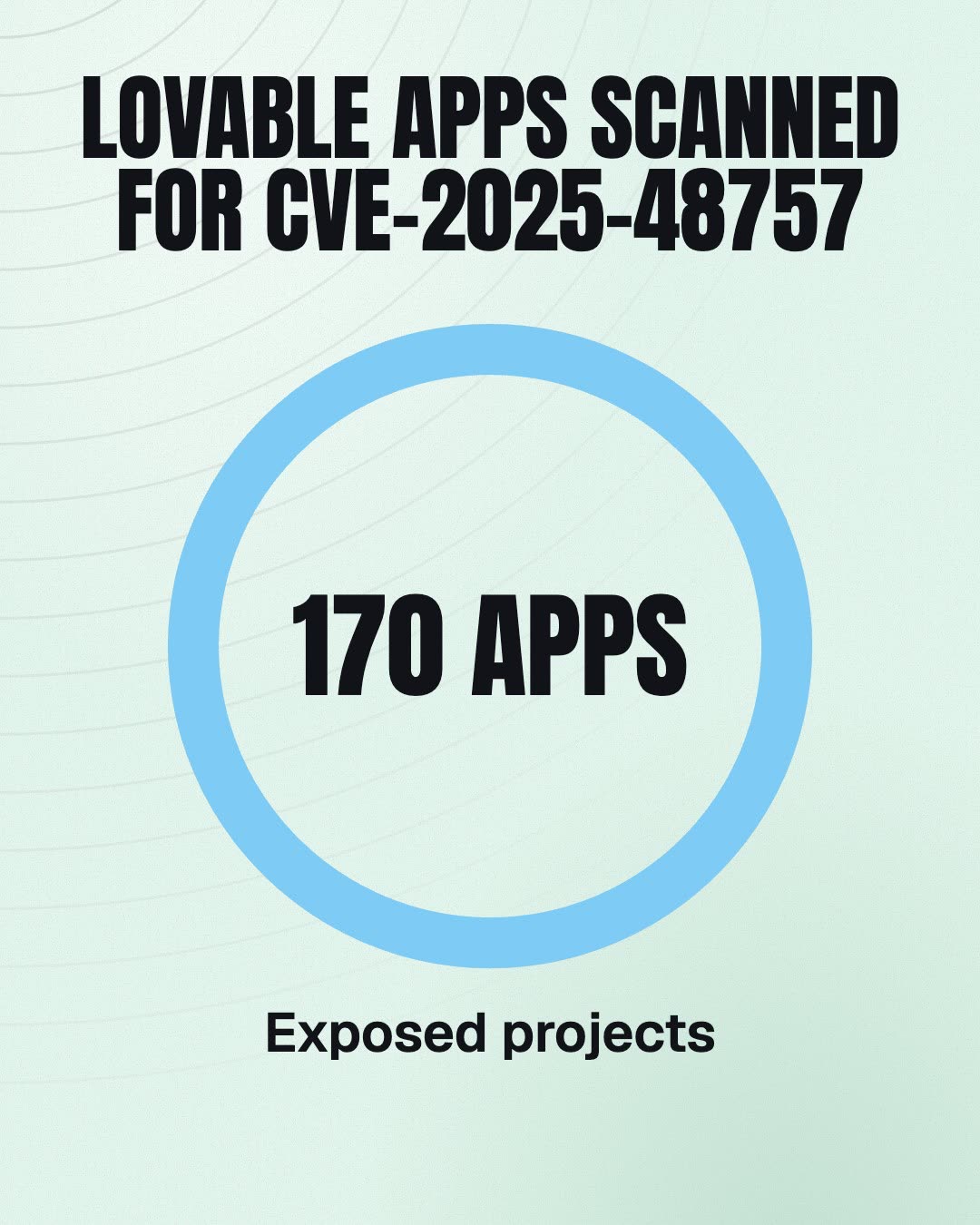
In March 2025, researcher Matt Palmer scanned 1,645 apps from Lovable's showcase. He found 303 exposed endpoints across 170 projects, about 10.3% (CVE-2025-48757). The cause wasn't a leaked key. It was missing row-level security, the database rules that decide which rows each user is allowed to read. The exposed data included subscriptions, names, phone numbers, API keys and payment details.
SaaStr puts it bluntly: prosumer builders aren't as secure as Squarespace or Shopify out of the box, "not even close". Its own first auth system was too complex to work, and "it broke and leaked data". Agents also make it worse by sounding sure. Lemkin says an agent will promise you a login flow is "enterprise-grade secure". He calls agents goal-seeking: they're trying to give you the answer you want.
- Log in as user A and change the URL to reach user B's data.
- Search your code for API keys. None should be hard-coded.
- Rate-limit your endpoints.
- Collect as little personal data as you can.
These checks are free. A professional security audit typically costs $5K–$15K, and SaaStr suggests one once you have meaningful traction. It also advises getting a developer with application-security experience to go over everything once you're in production.
5. Maintenance never ends
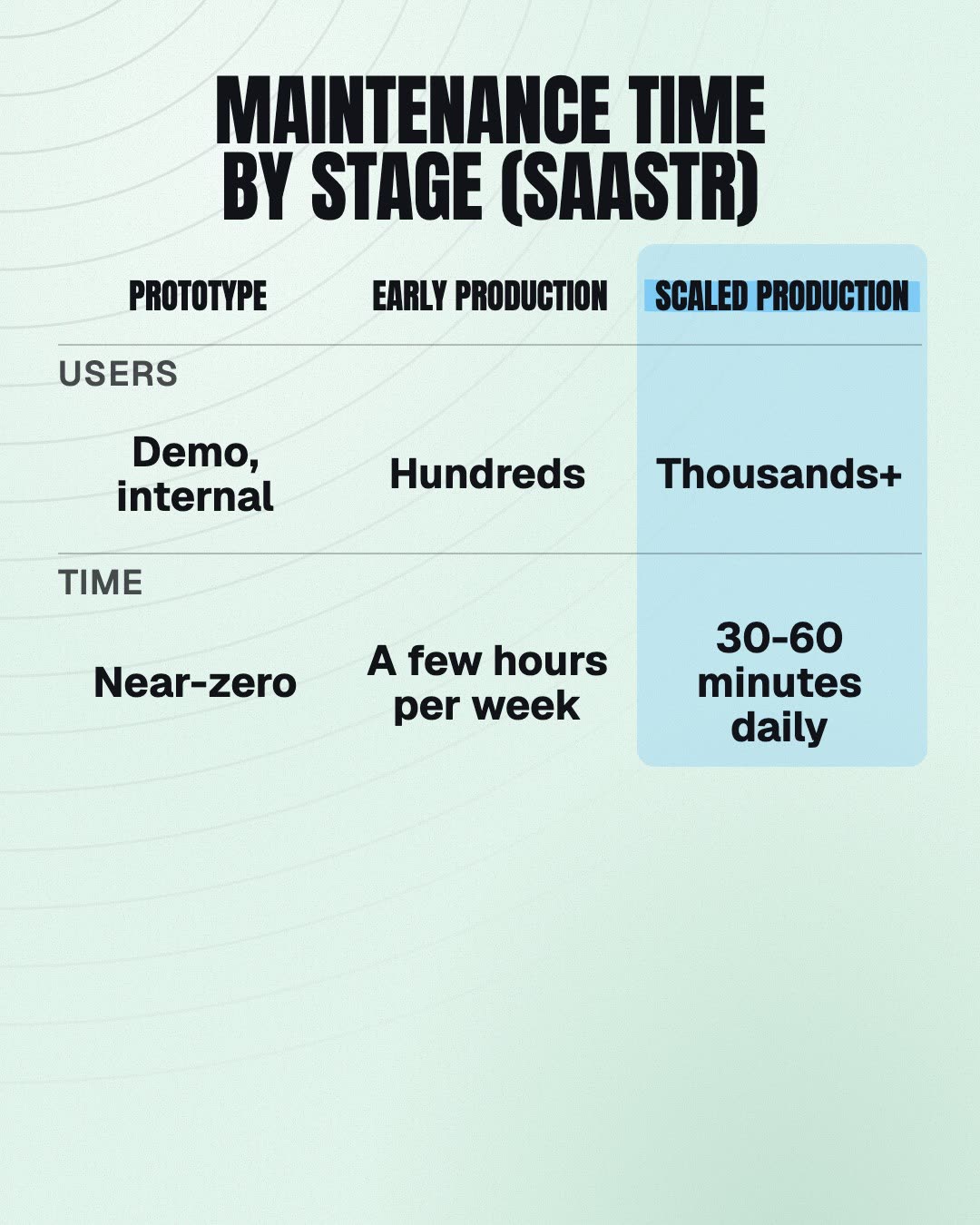
Lemkin's count after 12+ apps: a prototype needs almost no maintenance. Early production with hundreds of users takes a few hours a week. Scaled production with thousands of users takes 30–60 minutes a day minimum, "plus significant mental overhead" (SaaStr). Email breaks, OAuth connections fail and databases go down. He also tells you to assume every component will be rewritten at least twice.
Smaller teams feel it sooner. On Product Hunt, a founder with no engineering background wrote: "Launch went fine but since then I've had three separate production issues". They asked whether ongoing paid support would be worth it (Product Hunt).
Fix it yourself or call an engineer: where the line is
You can usually stabilise the app yourself while it's simple, holds little personal data, runs on built-in auth and payments, and the fixes come straight from the checklist below.
- You store sensitive data, or take payments beyond the built-in tools.
- Every fix breaks something else.
- You're stuck in debugging loops the agent can't close.
- A big launch or a paying customer is coming.
- You need a security review.
If any of those sound familiar, bring in an engineer. Plan for that handover early. SaaStr warns that most developers don't want to inherit vibe-coded apps, because the code is often called "spaghetti", and shops that take them over are rare and expensive. Pick tools that let you export the code and keep it in Git. A split that works: you own the product and the architecture decisions, and the AI writes the code.
Limits of this evidence
- It's all self-reported, mostly by one team (SaaStr) and forum posters.
- The sample leans toward people who shipped and then wrote about it. Quiet failures don't post.
- The Lovable scan only checked homepages, not logged-in areas, so its numbers are likely a lower bound.
- The tools change fast, so a specific bug from 2025 may already be fixed. The pattern is what to keep.
The pre-launch checklist, and what we'd do
- Test with real data size: 100x what you have, plus edge cases and mobile.
- Separate dev and production, each with its own database.
- Keep backups the agent can't touch, and know your rollback.
- Keep secrets and API keys out of the code.
- Check that user A can't see user B's data.
- Use the platform's built-in auth.
- Add daily health checks and error alerts.
- Keep a regression list and click through it after every change.
Building the app in a weekend is real. Keeping it running for the month after is the actual job. If your app already has users and this list turned up problems, we can help you stabilise it: work with us.