
If you deploy an AI app on a hosting platform, your OpenAI, Anthropic or Bedrock key probably sits in that host's dashboard as an environment variable. In October 2026 that became the weak spot. Wiz counted at least nine AI developer platforms that disclosed incidents in a single month and called it "Black October".
The attackers didn't go after developers one at a time. Every public report describes the same target: stored environment variables, especially the ones that grant access to AI models. Wiz found no single vulnerability or dependency linking the incidents. What they share is where the keys were kept.
That's the uncomfortable part for small teams. As the Cloud Security Alliance research note points out, once you paste a key into a host, its safety depends on that host's build system and secret store, not on you. Below we cover what happened, what two stolen keys cost, why deleting a key on the host doesn't help, and a checklist you can finish in one afternoon.
The timeline: nine disclosures in 25 days, and more since
Wiz lists the disclosures in order:
- Oct 6: Fireworks AI
- Oct 9: Andromeda
- Oct 14: Zeabur
- Oct 15: Lightning AI
- Oct 16–17: OpenCode
- Oct 20: Railway
- Oct 23: Warp
- Oct 28: CommandCode
- Oct 30: Northflank
Zeabur published the fullest account. An attacker used leaked internal credentials stored in plaintext, including cluster admin tokens with no expiry. They read about 3.2 million environment-variable records and account data for 321,810 accounts. Zeabur doesn't hedge: "The root cause of this incident lies with Zeabur", meaning long-lived admin credentials in plaintext that could be used from the public internet (Zeabur's report). The tokens hadn't been rotated since January 2024, and the company will shut down by December 31, 2026.
One Zeabur detail matters for anyone who runs automations. 602 of 607 checked n8n instances stored their encryption key as an environment variable. So the third-party credentials saved inside those workflows were exposed as well.
Railway's preliminary report says the attack was trying to get AI provider API keys for distillation, meaning mass queries to frontier models whose answers are used to train other models. At most 1.85% of workspaces, about 100,000, had environment variables potentially compromised. Railway recommends that everyone who signed up before October 21 rotate the keys stored there.
Northflank went further. Its status page told customers to assume all environment variables had been decrypted and to disable or rotate all keys.
It didn't stop on October 31 either. Wiz kept updating its post: on November 2 it added Brev (NVIDIA) and Trigger.dev, and more disclosures followed.
Why deleting the key on the host does nothing
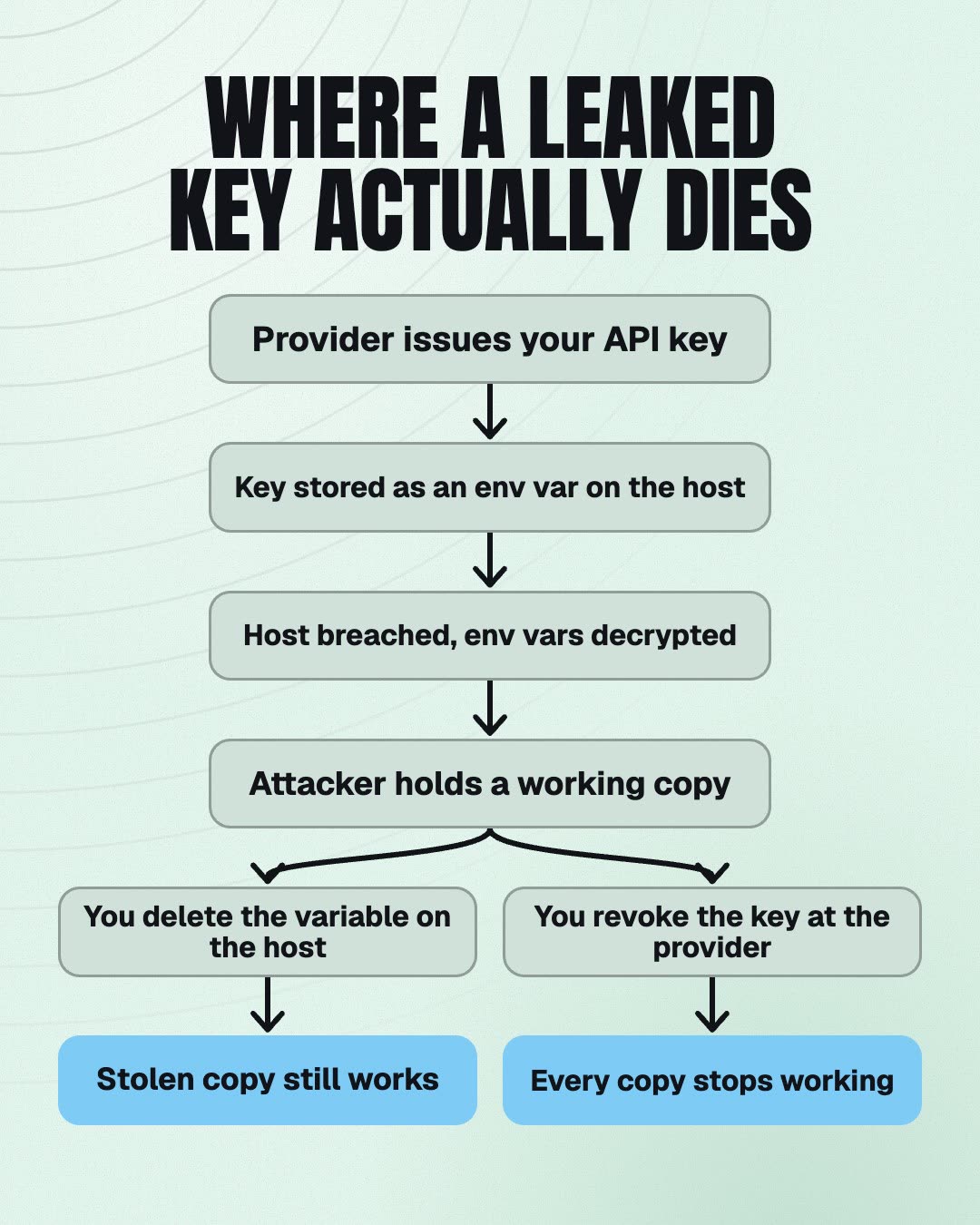
A host has to be able to decrypt your secrets to inject them into running apps. That's how environment variables work. So "encrypted at rest" stops helping once an attacker reaches the build system or the path that does the decrypting. Railway's timeline shows exactly that: the attacker first pulled encrypted secrets, then got into the CI environment and decrypted a subset.
Fireworks' security bulletin says it plainly: "Removing a stored secret alone does not invalidate the underlying credential." The attacker already has a copy. Deleting yours only means you can't use it anymore.
Only the company that issued the key can kill it: OpenAI, Anthropic, AWS, GitHub, Stripe. That's why Railway itself worked with GitHub, GitLab, Anthropic, OpenAI, OpenRouter, Stripe and others to revoke potentially compromised keys.
The order matters too. The CSA note is explicit: creating a new key without revoking the old one leaves the stolen key active. Rotation means revoke at the provider, not just add a fresh key next to the old one.
And who pays? Railway says it can't refund spend made with compromised keys and points users to the AI providers directly. If you find abuse, report it to the provider quickly.
What a stolen key costs: two Bedrock cases from Wiz
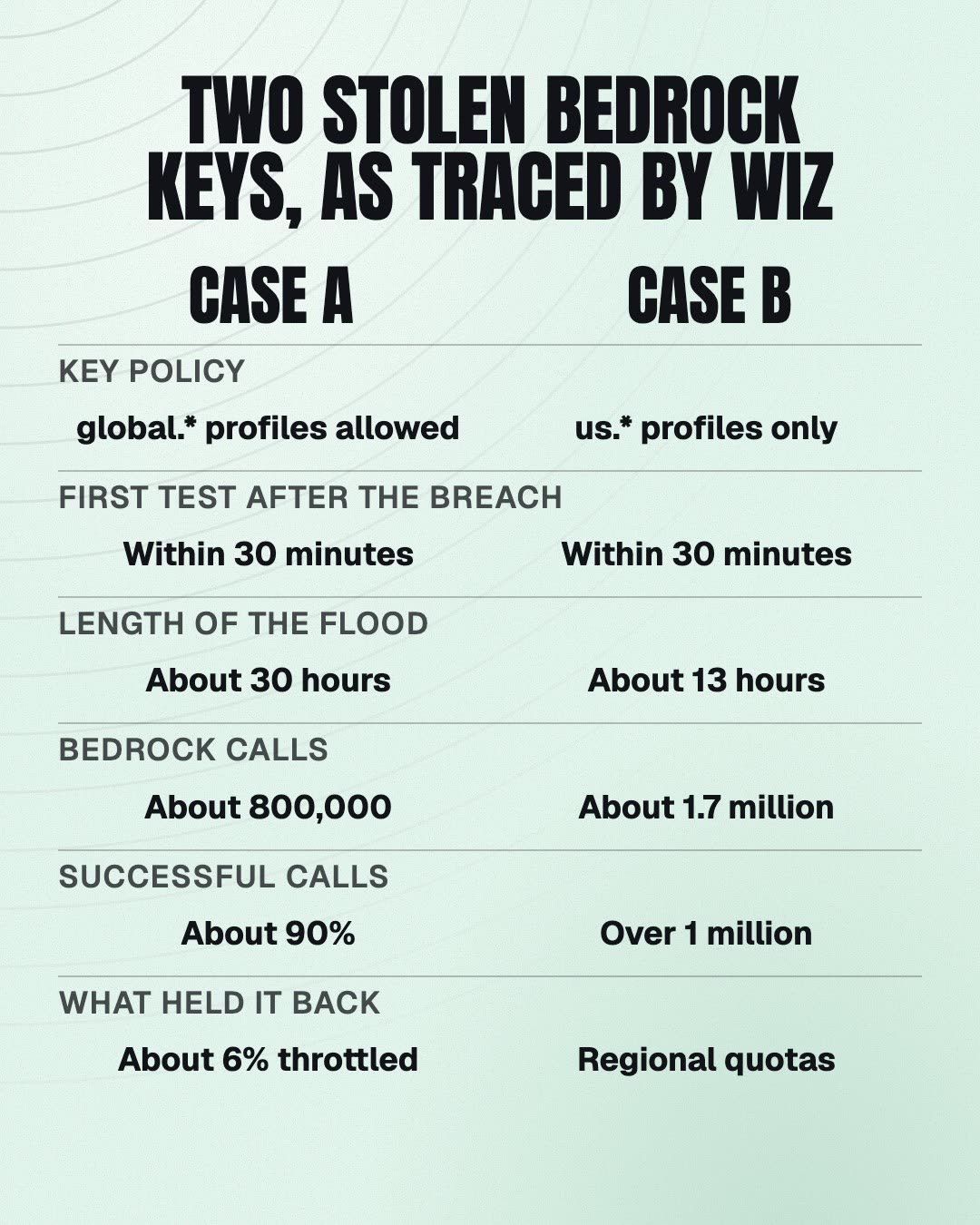
Wiz followed two enterprise Amazon Bedrock keys whose theft it could tie to one of the vendor breaches. Both were first used within 30 minutes of the credential access at the vendor. Then, for days, almost nothing happened: 14–120 calls a day from the same small Go client, just checking that the keys still worked.
Then came the floods:
- Case A, an unrestricted key that allowed global cross-region inference profiles: about 800,000 Bedrock calls in 30 hours, about 90% of them successful, until the key was remediated.
- Case B, a key restricted to US regional profiles: about 1.7 million calls in 13 hours from a single address, over a million successful. Most of the rest were throttled by the account's regional quotas.
At list price, Wiz estimates these two cases alone likely ran up over $100,000 in usage.
Here's the lesson about scoping. The restriction on Case B didn't prevent abuse at scale. As the CSA note puts it, it bounded throughput to regional quotas, and together with spend limits that buys defenders time to detect and revoke. Treat a narrow key as damage control, never as a substitute for fast revocation.
The quiet days are worth noticing. A handful of calls a day from an unknown client is easy to miss on a bill, and it's exactly the window where an alert would have caught both keys before the flood.
Wiz also found two resale sites offering discounted access to frontier models that had and tested these keys. It couldn't definitively link them to the breaches or the floods. Reports of consumer bills in the hundreds to thousands of dollars, for example from OpenCode keys, come from social media and haven't been confirmed.
The one-afternoon checklist
None of this needs a security team. A small team can get through it in an afternoon:
- Make an inventory. Every AI key, which host it lives on, which environment. Include preview environments, eval jobs and personal accounts used for work.
- Revoke at the provider, then reissue and redeploy. If a key was already abused, revoke it first, even if that means some downtime. Rotate the non-AI secrets on that host too, plus n8n's encryption key and the credentials stored in its workflows.
- Check billing and usage since October 1. Look for unfamiliar models, regions, IPs and traffic at odd hours. A small trickle counts.
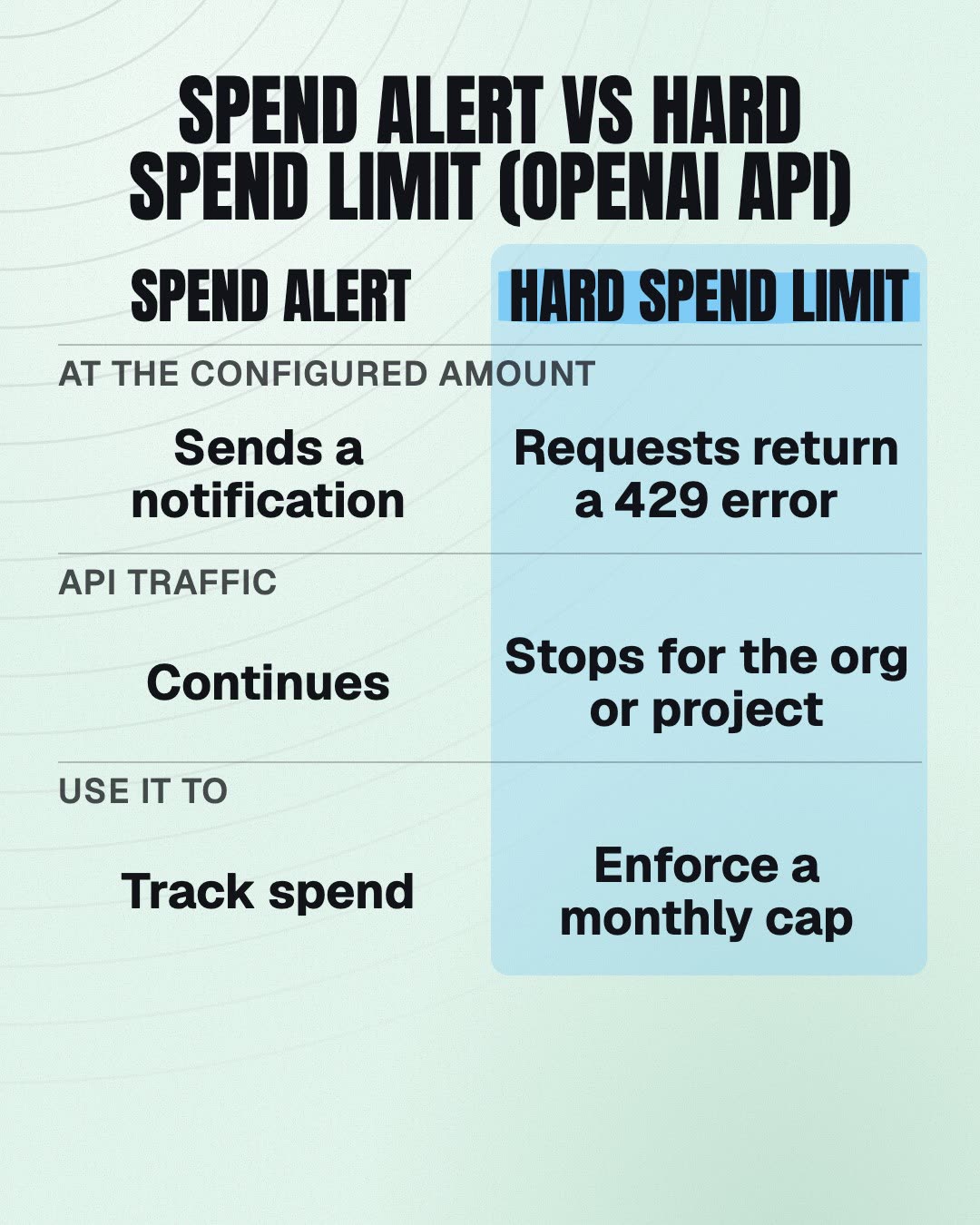
- Set hard caps, not just alerts. OpenAI's spend alerts only notify you; a hard spend limit makes requests fail with a 429 error. Anthropic workspaces let you set a monthly spend limit per workspace.
- One key per app and per environment, each in its own workspace or project. A leak then means one rotation and a bill you can read.
- Use short-lived keys where you can. Amazon Bedrock short-term API keys last up to 12 hours.
- Set alerts that wake someone up: a first call from a new network, a model your app never uses, quota or limit checks, and spend above your normal daily baseline.
Limits and open questions
There's a lot we still don't know:
- Most root causes are unpublished. Zeabur has a full write-up and Railway a preliminary report. The rest are still being analyzed, and nobody knows how many keys were taken in total.
- Attribution is open. Wiz doesn't claim one group ran all the breaches, and it doesn't link the resellers to the intrusions.
- Moving keys moves the risk. An AI gateway or key broker that holds all your provider keys becomes a target itself. Choose where your keys live on purpose, not by default.
What we would do
Assume any long-lived AI key stored on a third-party host could leak someday, through no fault of yours. Then give each host a key it can afford to lose: its own key, a hard cap close to real usage, and an alert that fires the same day. If it leaks, you revoke one key at the provider and move on.
Black October wasn't about one careless developer. It was about where keys pile up. You can't fix your host's secret store, but you can decide how much a stolen key is allowed to cost. For more practical guides on building and automating with AI, see our learning hub.