On current list prices, 1,000 answers from a 50-page knowledge base cost a few dollars with a cached long-context model or with RAG. With a product priced at $0.99 per outcome, the same 1,000 conversations cost hundreds of dollars. That gap is what this article is about.
It's a fair question: do you still need RAG now that context windows hit 1M tokens? The honest answer depends on two numbers: how big your docs are and how many questions you get.
Three ways to build a docs assistant, and our assumptions
- Long context: paste the whole knowledge base into the prompt and cache it.
- RAG: split the docs into chunks, embed them, store them in a vector database and send only a few chunks per question.
- Hosted assistant: OpenAI file search, which you call from your own app, or a helpdesk product priced per resolution, like Intercom Fin.
So you can redo the math, here are our assumptions. They're ours, not figures from any provider: about 500 tokens per docs page, so 50 pages ≈ 25,000 tokens and 2,000 pages ≈ 1,000,000 tokens. Each answer is about 300 output tokens, and questions are short. Prices are list prices from the provider pages as of November 2026.
Option 1: paste the docs and cache them
The whole knowledge base sits in the system prompt. Prompt caching means you pay a bit extra to write it once, then a fraction of the price every time it's read.
On Anthropic's side, per the prompt caching docs, a cache read costs 0.1× the base input price, a 5-minute write 1.25× and a 1-hour write 2×. The default cache lives 5 minutes and refreshes for free each time it's used. Claude Haiku 4.5 costs $1/MTok input, $0.10/MTok for cache hits and $5/MTok output. The minimum cacheable prompt on Haiku 4.5 is 4,096 tokens, so 50 pages clear it easily.
OpenAI caches by default on supported models, with cached input discounted by up to 95%. On the pricing page, gpt-5-mini cached input is $0.025/MTok and output $2.00/MTok.
50 pages: about $4 per 1,000 questions
With Haiku 4.5: 1,000 × 25k cached tokens = 25M × $0.10 = $2.50, plus 300k output × $5 = $1.50. That's about $4, plus a few cache writes a day at roughly three cents each (25k × $1.25/MTok). The same math on gpt-5-mini comes out near $1.25 (25M × $0.025 + 300k × $2).
2,000 pages: about $100, if it fits at all
Now every question carries about 1M tokens. That's far past Haiku 4.5's 200k window and right at the 1M window of the newest Claude models (context windows). The Claude Opus 4.7 page also notes that on the tokenizer introduced with Opus 4.7, 1M tokens is about 555k words, compared with about 750k words before. That's roughly 35% more tokens for the same text, so your docs may not fit. Even if they do, Sonnet 5.5 cache hits at $0.10/MTok give 1,000 × 1M × $0.10 ≈ $100 per 1,000 questions in cache reads alone, and every answer waits on a million-token prompt.
Accuracy suffers too. Chroma's context rot study found that model performance consistently degrades as input grows, and Anthropic's own docs say accuracy and recall degrade as token count grows. For citations, send the docs as document blocks with citations enabled (all active Claude models support it), or ask the model to name the section it answers from.
Upkeep: almost none. Update the docs file and the next request rebuilds the cache. Wins when the docs are tens of pages, traffic keeps the cache warm, and you want it running this afternoon.
Option 2: build RAG with a vector store
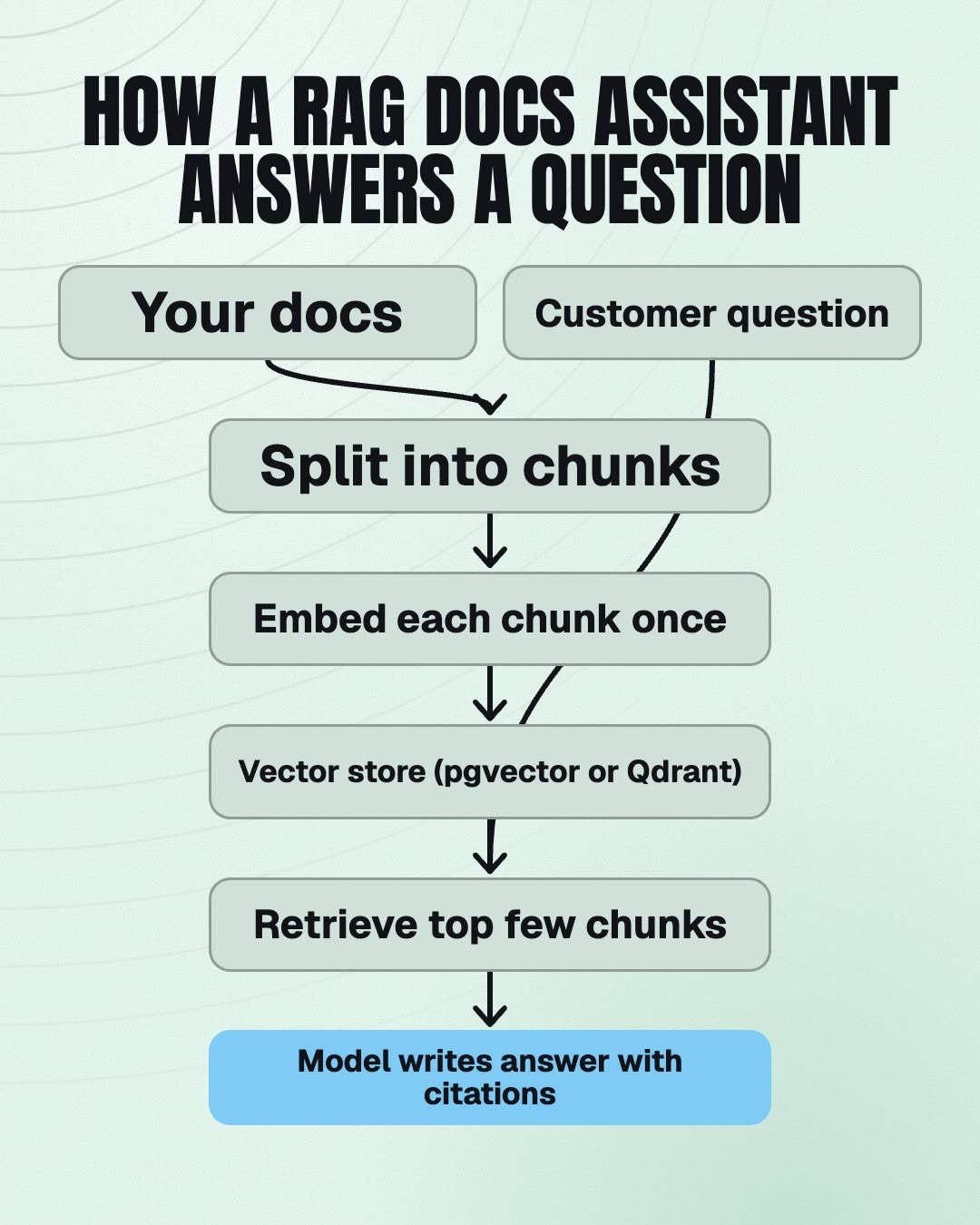
Split the docs into chunks, embed each one once, store the vectors. For each question, pull the top few chunks and send only those to the model.
- Indexing is close to free: text-embedding-3-small costs $0.02 per 1M tokens, so embedding a 1M-token knowledge base costs about two cents. Re-embedding after edits costs about the same.
- Storage fits free tiers: Qdrant Cloud's free tier is a single node with 0.5 vCPU, 1 GB RAM and 4 GB disk. Supabase's free plan includes a 500 MB database per project; Pro starts from $25/month.
- Per question: about 5 chunks × 800 tokens plus the prompt ≈ 4,500 input tokens.
With gpt-5-mini ($0.25/MTok input, $2.00 output): 4.5M × $0.25 ≈ $1.13 input plus 300k × $2 = $0.60 output, so about $1.75 per 1,000 questions. And it's almost the same at 50 pages and at 2,000, because each question only sees a few chunks.
Accuracy is good when retrieval finds the right chunk, and confidently wrong when it doesn't. Typical failures: a table split across chunks, an answer spread over two pages, the wrong product version. Citations are easy, because you know exactly which chunks you sent.
Upkeep is where the real cost sits: engineering time. You own chunking, re-indexing when docs change, the retrieval code and a small eval set. Wins when the docs run to hundreds of pages, change often, or you need citations and control over the stack.
Option 3a: OpenAI file search, RAG you don't host
You upload files to a vector store, and the Responses API searches them as a tool. OpenAI handles chunking (800-token chunks with 400 tokens of overlap by default), embeddings and retrieval. Answers carry file_citation annotations that point to the file, though raw search results aren't returned by default.
Price: $2.50 per 1,000 tool calls. Storage is $0.10 per GB per day, with the first GB free. Model tokens for the retrieved text come on top. With gpt-5-mini that's $2.50 in calls plus roughly the same ~$1.75 in tokens as DIY RAG: about $4 per 1,000 questions, with no storage bill as long as the store stays under 1 GB.
The billing confusion is real. In an OpenAI community thread, a user reported about $0.03 for a single search instead of the expected $0.0025, with amounts that varied. Another reply pointed out that the standalone vector store search endpoint is missing from the pricing information.
- Files can be up to 512 MB and 5,000,000 tokens each.
- max_num_results lowers token use and latency, but may reduce answer quality.
- Wins when you want RAG with citations this week and you're fine staying with one vendor.
Option 3b: Intercom Fin, paying per resolution
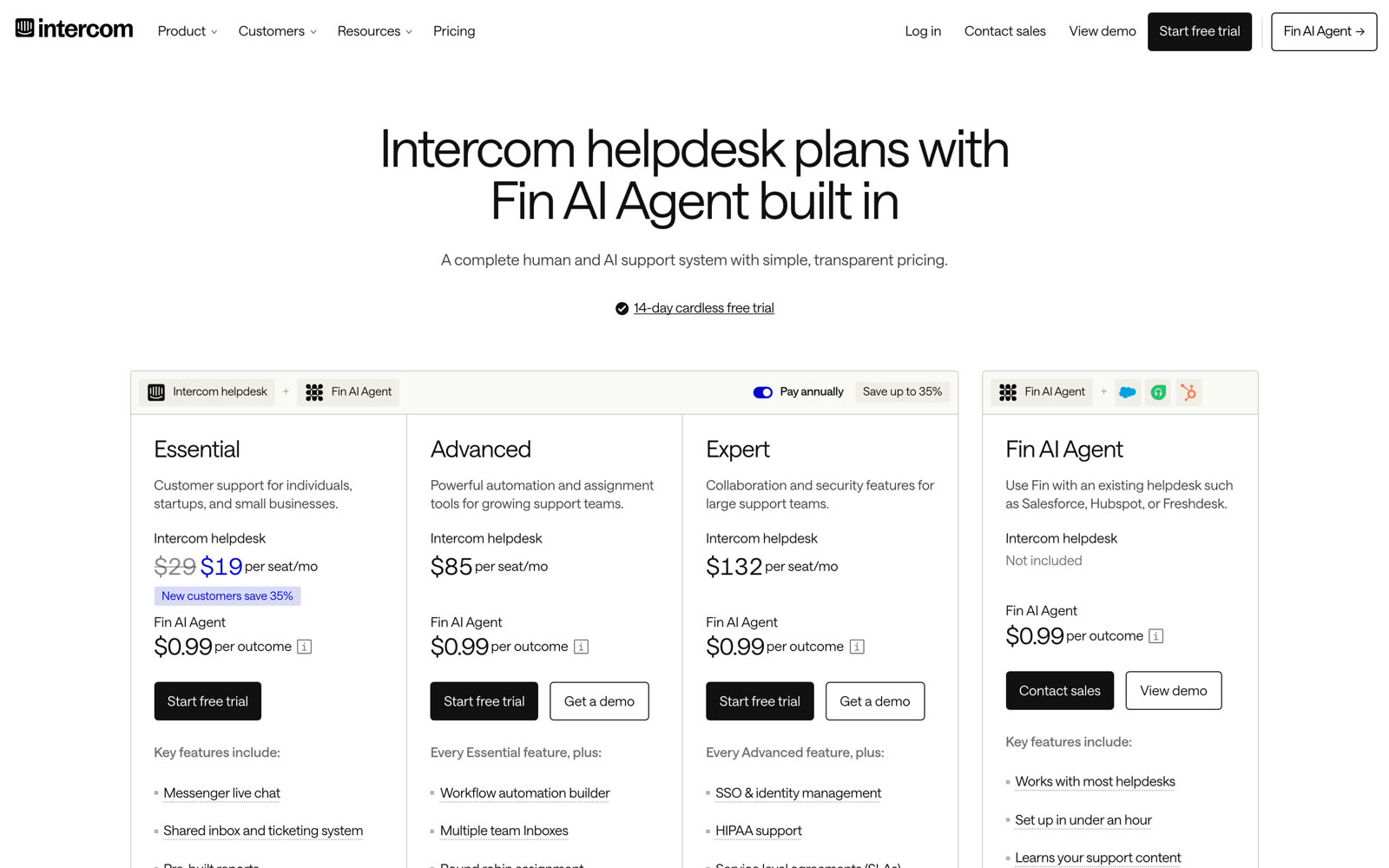
Intercom prices Fin at $0.99 per outcome. Used with another helpdesk, there's a minimum monthly commitment (Intercom's example is 50 outcomes). Inside Intercom's own helpdesk you pay for seats on top.
According to Gleap's breakdown, an outcome is charged at most once per conversation, and you don't pay when Fin can't answer or fails an action. A dev.to analysis quotes Fin's rule that a customer going quiet for 24 hours after Fin's last answer counts as an assumed resolution.
If 50–70% of conversations become outcomes (the dev.to analysis's assumption, not an Intercom figure), 1,000 conversations cost $495–$693 before seats. The same analysis puts a 10-person team with 2,000 AI conversations a month at $2,130–$2,526 with Advanced seats and Copilot. Billing is per conversation, not per question, so the comparison with token prices is rough.
What you get for that money: an inbox, handoff to humans, workflows and reporting, with no tokens, chunks or evals to manage. You're paying for a support product, not for answers alone. Wins when you already run support in a helpdesk, a resolved ticket is worth more to you than a dollar, and nobody wants to own an AI pipeline.
Side by side: cost, accuracy, upkeep
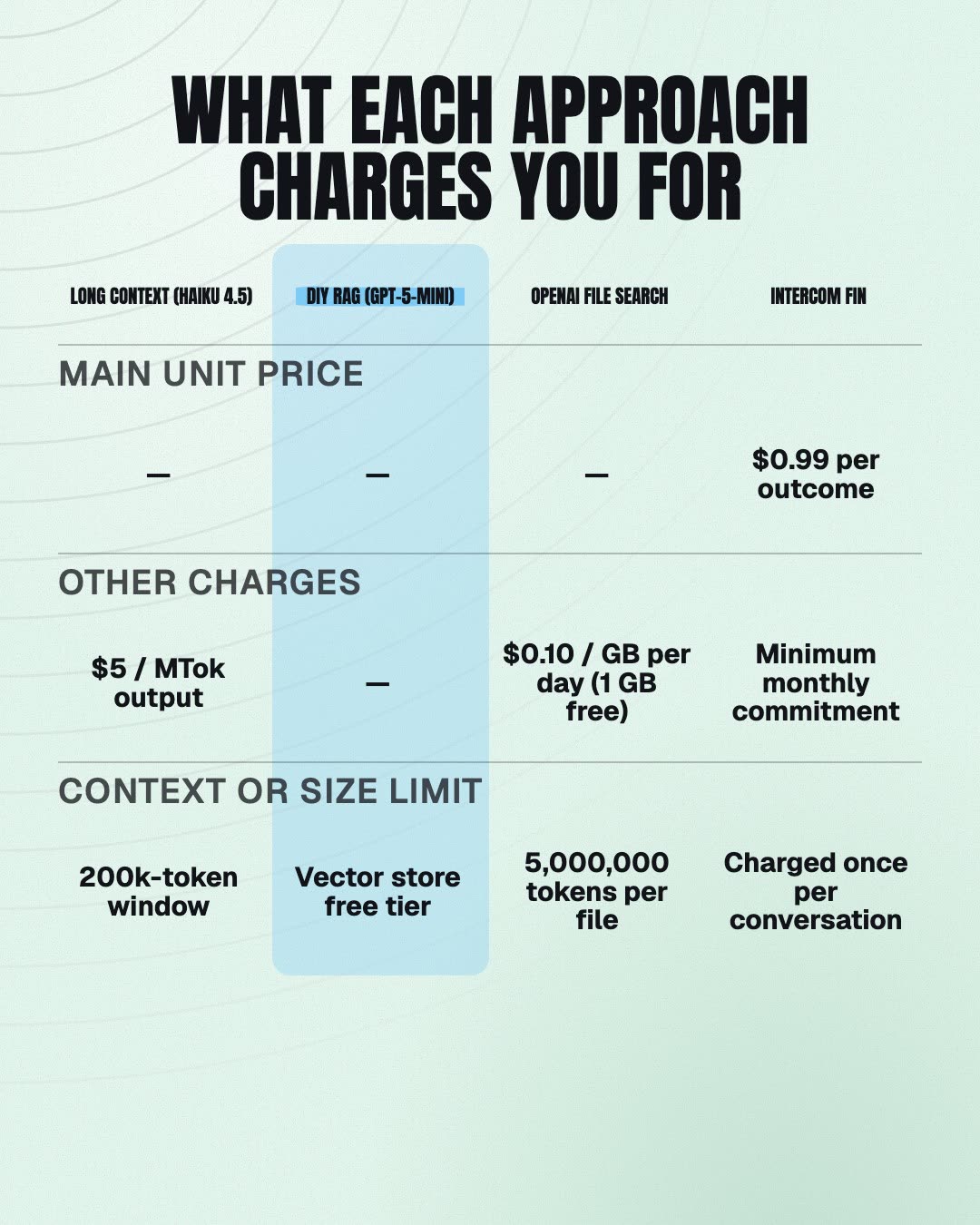
- Cached long context: ~$4 per 1,000 questions at 50 pages (Haiku 4.5); ~$100 or doesn't fit at 2,000 pages. Citations through Claude's document citations or by asking for the section, almost no upkeep.
- DIY RAG: ~$1.75 at both sizes (gpt-5-mini). Easy citations, you own the pipeline.
- OpenAI file search: ~$4 at both sizes. File citations, one vendor, little upkeep.
- Intercom Fin: ~$495–$693 per 1,000 conversations at any size, before seats. Full helpdesk, nothing to build.
In plain words: at 50 pages, everything except Fin costs a few dollars per 1,000 questions. At 2,000 pages, long context jumps to about $100 or stops fitting, while RAG stays put. These are worked examples on list prices with our assumptions. Real bills move with answer length, conversation turns and cache hit rate.
What we would do
- Under ~100 pages: start with long context and caching on a small, cheap model. Turn on citations for the docs, or tell it to name the section it answers from. Ship it, log every question, review the logs weekly.
- Docs growing past a few hundred pages, or answers getting vague: move to RAG. OpenAI file search if you want it running fast; pgvector or Qdrant on a free tier if you want control and no lock-in. Keep the same eval set so you can see whether it actually got better.
- Support already lives in a helpdesk and no developer is free: price Fin against your monthly resolved tickets, seats included, before you sign.
Don't build a vector pipeline for 50 pages, and don't send a million tokens with every request. Pick the simplest option that fits your docs today, and measure before you upgrade.
Want help choosing or building a docs assistant for your product? Work with us.