
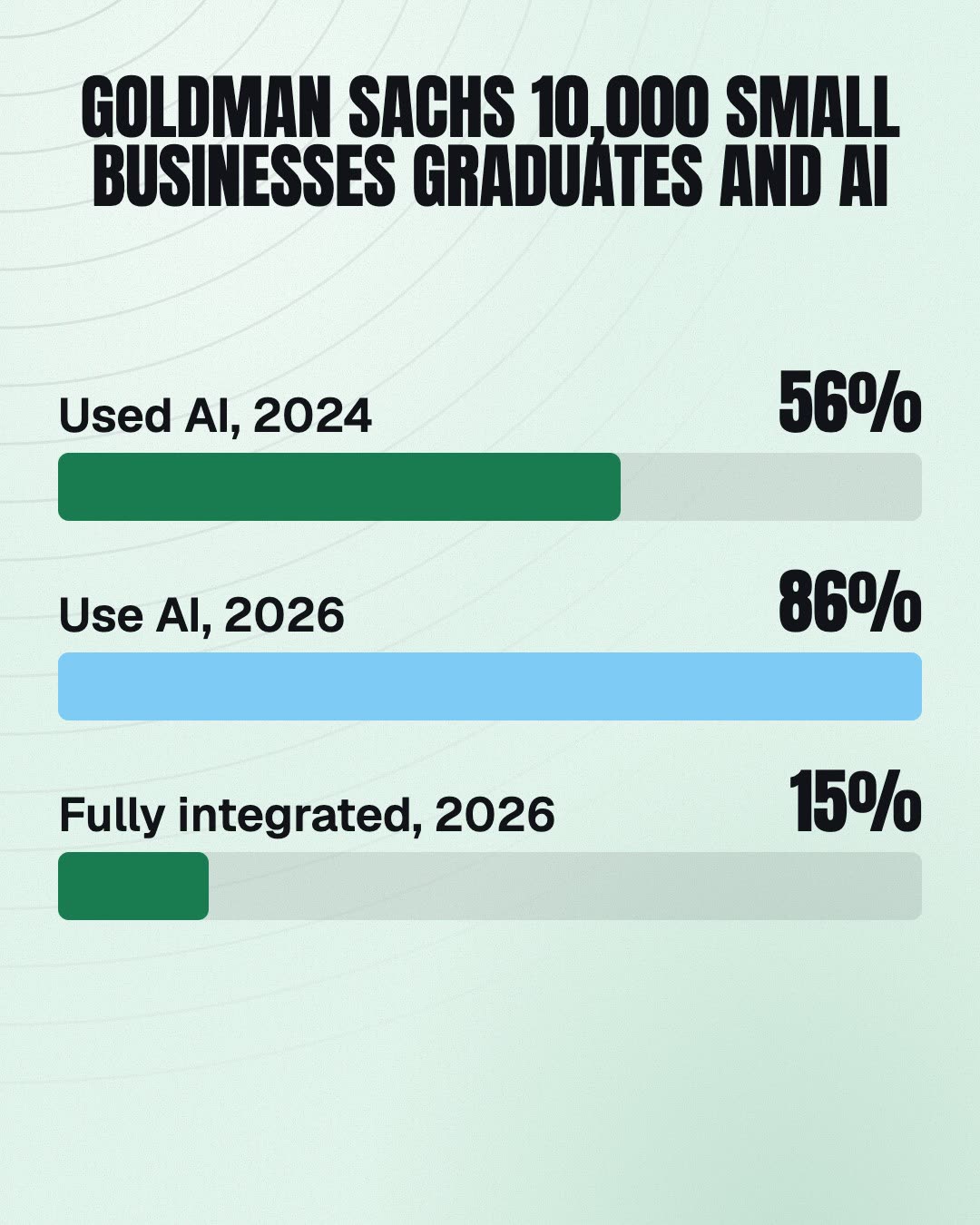
In Goldman Sachs' October survey, 86% of small-business owners said they use AI. Only 15% said it is fully integrated into their core operations. That gap matters more than any adoption headline you'll read this year.
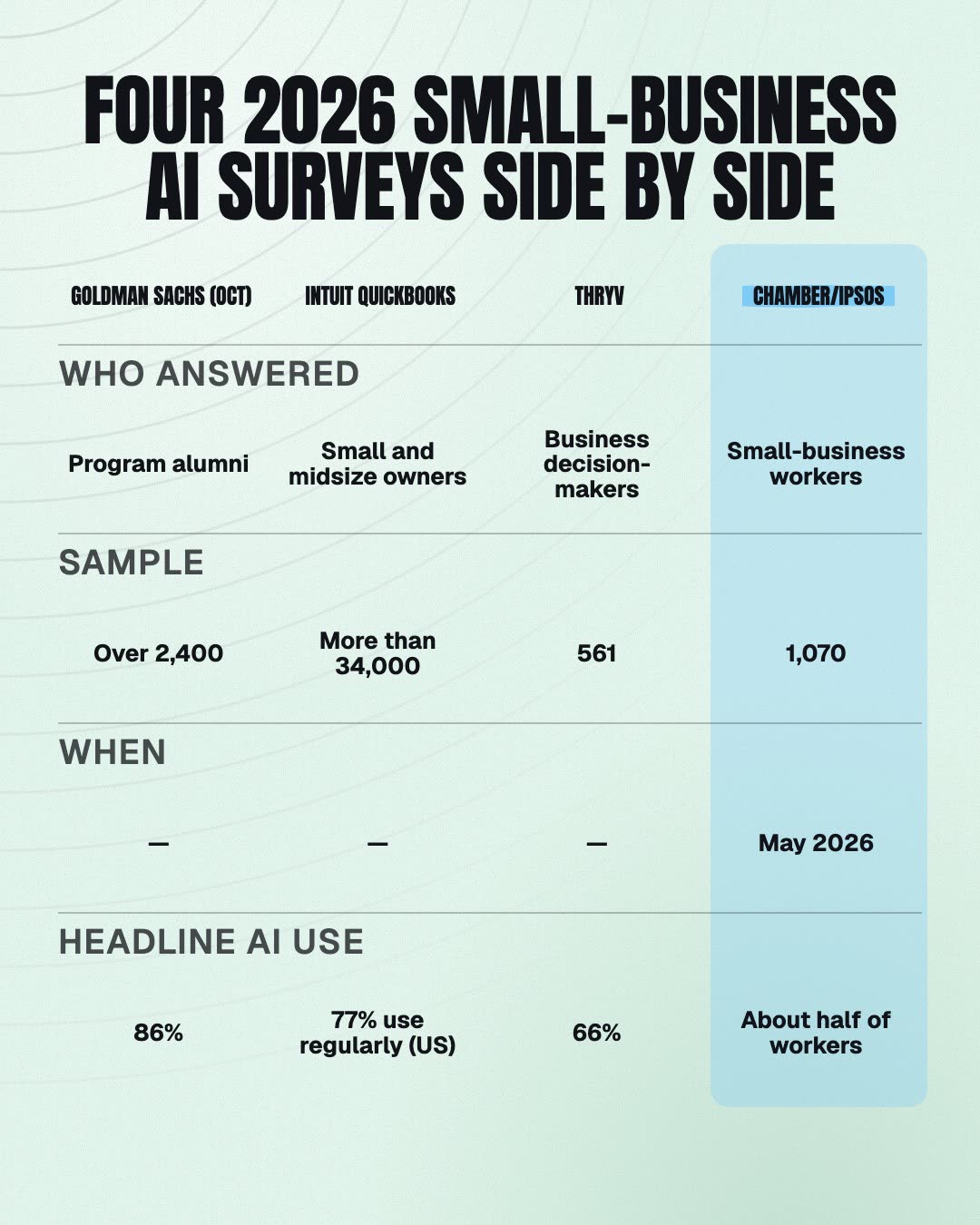
And there have been plenty of headlines. In 2026 alone, Goldman Sachs reported 76% in March and 86% in October. Intuit said 77% of US businesses use AI regularly. Thryv said 66%. The US Chamber of Commerce Foundation and Ipsos said about half of small-business workers use AI at work. So which is it?
They can all be right at the same time. "Use" covers everything from one person drafting emails in ChatGPT to AI built into how the business runs. Below we put the samples, wording and respondents side by side, show what the surveys agree on and finish with three things a small team can do this month. This is our reading of published surveys, not our own data.
Who was asked, and how: why the numbers differ
Each survey asks a different group of people a slightly different question. Here's what's behind each number.
- Goldman Sachs 10,000 Small Businesses, March: 1,256 program participants, surveyed by Babson College and David Binder Research from January 27 to February 4, 2026. Result: 76% use AI, 14% say it's fully embedded in core operations (press release).
- Goldman Sachs, October: over 2,400 program alumni (the report page says 2,474), surveyed August 10–24, 2026. Result: 86% use AI, up from 56% in 2024, and 15% fully integrated (press release).
- Intuit QuickBooks: more than 34,000 small and midsize owners plus anonymized data from more than 5.3 million QuickBooks businesses in the US, Canada, the UK and Australia. Result: 77% of US businesses use AI regularly, up from 48% in July 2024 (2026 AI Impact Report).
- Thryv: 561 US small and mid-sized business decision-makers (not Thryv customers), recruited through a third-party panel in April 2026. Most report $1M–1.9M in revenue. Result: 66% adoption, up from 55% a year earlier (CPA Practice Advisor).
- US Chamber Foundation/Ipsos: a nationally representative probability sample of 1,070 workers at firms with 2–499 employees, May 8–11, 2026. Result: about half use AI at work (Main Street AI Monitor). A companion survey interviewed 750 owners and operators (owner survey).
A few patterns explain most of the spread. Goldman's respondents went through a business-education program, so they aren't a random sample, and the October report itself says its findings reflect the surveyed businesses, not all US small enterprises. Its 76% and 86% also come from different groups (participants and alumni), so the jump isn't a clean trend.
Intuit's definition is broad on purpose: "any kind of AI use, from free tools and built-in features to dedicated paid subscriptions." Its survey answers come from more than 34,000 owners, and only its separate payment data comes from QuickBooks businesses. Thryv sells an AI-enabled marketing platform, so keep the vendor angle in mind. And the Chamber/Ipsos tracker asks employees, not owners, which is one reason its number is lower.
What 'use' actually looks like
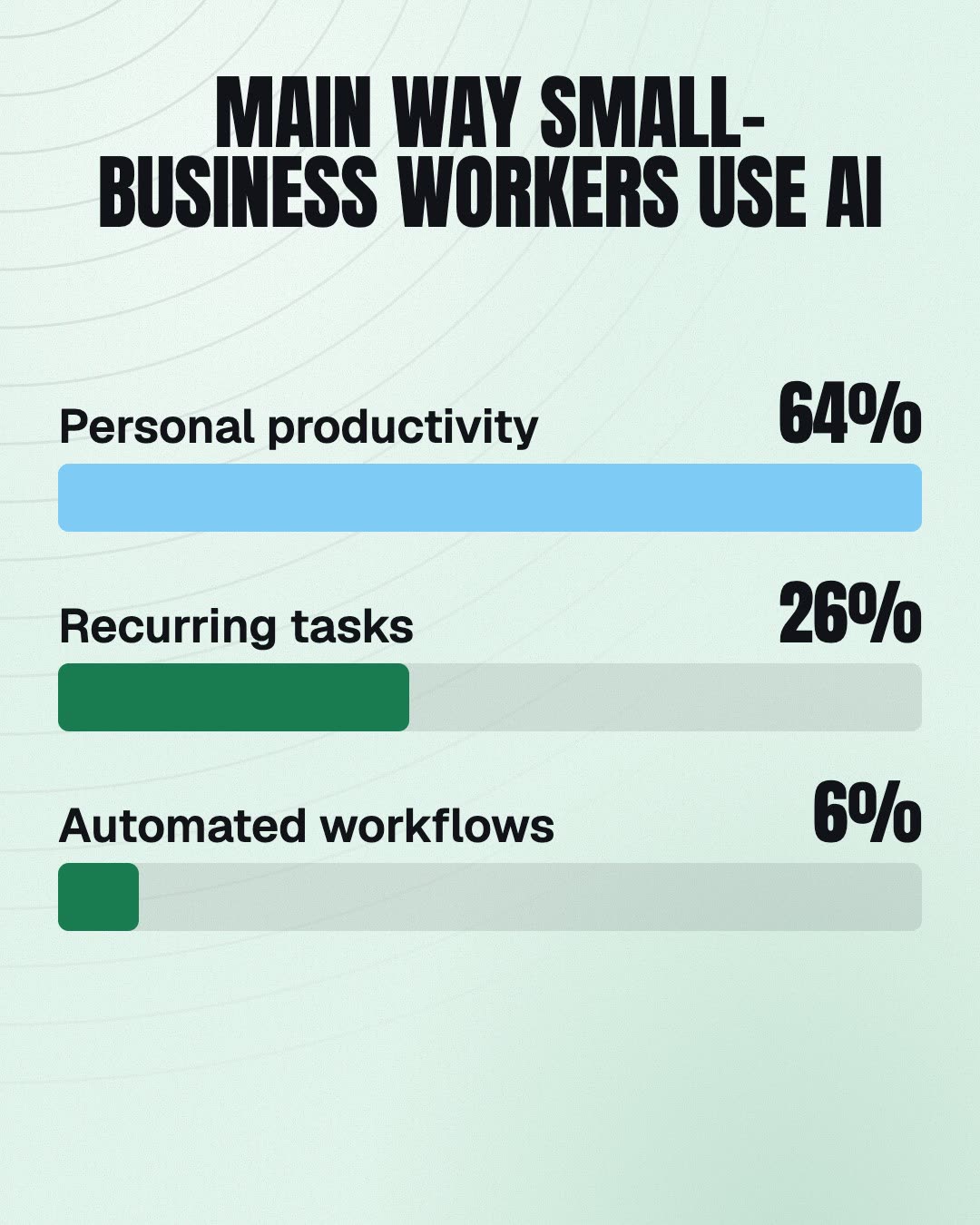
The Chamber/Ipsos worker data gives the clearest picture of depth. Among workers who use AI, 64% say their main use is personal productivity: drafting, summarizing, brainstorming. Another 26% use it for recurring tasks. Just 6% use it to automate workflows with minimal human involvement.
Goldman's October numbers say the same thing from the owner side. 15% of all respondents, or 18% of those using AI, have fully integrated it. The rest use it for selected activities or experiments (ANI via NewKerala).
Intuit's payment data adds a money angle. Only 12% of US businesses with observed payment records paid for dedicated AI tools between 2021 and 2025. But 86% of those that paid in 2024 were still paying in 2025. Few pay, and most who do keep paying.
Size matters too. Chamber/Ipsos found 43% of firms with 2–9 employees use AI for work tasks, against 59% of firms with 100–249. The smallest teams lag the most.
There's one sign that use is moving toward the core of the business. Among Goldman alumni who use AI, financial analysis and business planning grew from 18% in 2024 to 42% in 2026. Written marketing content fell from 74% to 65%.
Where all four surveys agree
The headline numbers differ. The findings underneath them line up surprisingly well.
Training is the gap
In Goldman's March survey, 73% said more training and implementation resources would help. In October, 77% of all respondents said so. In Thryv's survey, 70% need more training. On the worker side, only about one in 10 Chamber/Ipsos respondents were offered formal AI training.
People learn on their own, and policy lags
Thryv found 57% of owners learn mainly from YouTube and social media. At Chamber/Ipsos, 19% of workers say adoption was driven mostly by employees exploring tools, against 11% who say it came from organizational guidance. And 74% of AI-using Goldman alumni have no formal policy for how employees use it.
Barriers are trust and know-how, not price
- Goldman (March): data privacy and security 50%, lack of technical expertise 49%, difficulty choosing tools 48% (10KSB Voices).
- Chamber/Ipsos workers: privacy or security 47%, unclear how AI applies to their business 41%, skills gap 41%.
- Intuit: the top barriers cluster around privacy and security, fear of errors and uncertainty about what AI can do.
Productivity, not job cuts
84% of AI-using Goldman alumni report no workforce change because of AI, 6% reduced staff and 5% added positions. In March, 87% said AI augments rather than replaces employees. Intuit found four times as many US businesses say AI increased hiring as say it reduced it. Thryv: 13% hired fewer people because of AI. And 59% of AI-using workers in the Chamber/Ipsos survey put the time they save into more or better work.
What the numbers don't say
- Everything is self-reported. When most Goldman owners call their results "overwhelmingly positive", that's what they believe, not a measured outcome. Treat it as a signal, not proof.
- Selection bias points one way. Program alumni are more likely to be engaged with AI, and a survey commissioned by an AI vendor deserves a second look even when it uses an independent panel of non-customers. The national figure for very small shops is probably lower.
- Saved time isn't always extra output. 28% of Chamber/Ipsos workers use saved time to avoid overtime and 23% for breaks or personal tasks. That can be a fine outcome, but it's not extra revenue.
- There's no single trend line. Different years, groups and wording mean you can't chain these surveys together. Each one is consistent only with its own earlier waves.
- No survey tells you what to buy or what return your business will get.
So the useful question for a small team isn't "are we among the 86%?" You almost certainly are, or will be soon. The useful question is how to move from trying AI to running a few real workflows on it.
Three things a small team can do this month
- First, write a one-page AI policy. List the tools that are allowed, the data that never goes in (customer details, finances) and who checks the output. That deals with the most common barrier, privacy, and puts you ahead of the 74% of AI-using Goldman alumni with no formal policy.
- Next, turn one recurring task into a shared workflow. For example, weekly follow-up emails to customers or summaries of supplier invoices. Write the prompt down, have everyone use the same one, and have a person review the result. That's the step from the 64% "personal productivity" group to the 26% using AI for recurring tasks.
- Then, run one hour of structured training on that workflow instead of leaving people to YouTube. Track the time it saves for four weeks and decide where that time goes. 73–77% of Goldman's owners already say they want training, so offer it inside the team.
The short version
The 86%, 77%, 66% and "about half" don't contradict each other. They measure different people with different definitions. Read side by side, they say the same thing: most small businesses have tried AI, few have built it into core work, almost nobody has trained their team, and owners use it to get more done, not to cut staff. Aim at the gap between trying and integrating, not at the headline.
Want to turn one task into a working AI workflow, step by step? Start with our guides on /learn.