
In June 2025, two security researchers, Ian Carroll and Sam Curry, got into the admin side of McHire, the hiring chatbot used by 90% of McDonald's franchisees. They typed 123456 as the username and 123456 as the password (Ian Carroll's write-up).
McHire is built by Paradox.ai. Applicants chat with a bot named Olivia. It collects their contact details and shift preferences and gives them a personality test. The researchers only looked because people on Reddit were complaining that the bot gave nonsensical answers. The whole review took "a few hours".
Nobody needed clever hacking here. It took a forgotten test account and a missing access check. Below we cover what happened, what each side says, why AI chat tools hold so much personal data, and 10 plain questions you can send any AI vendor before you sign.
How two basic flaws added up
Carroll's post walks through the chain step by step. It's worth reading in full, but here's the short version.
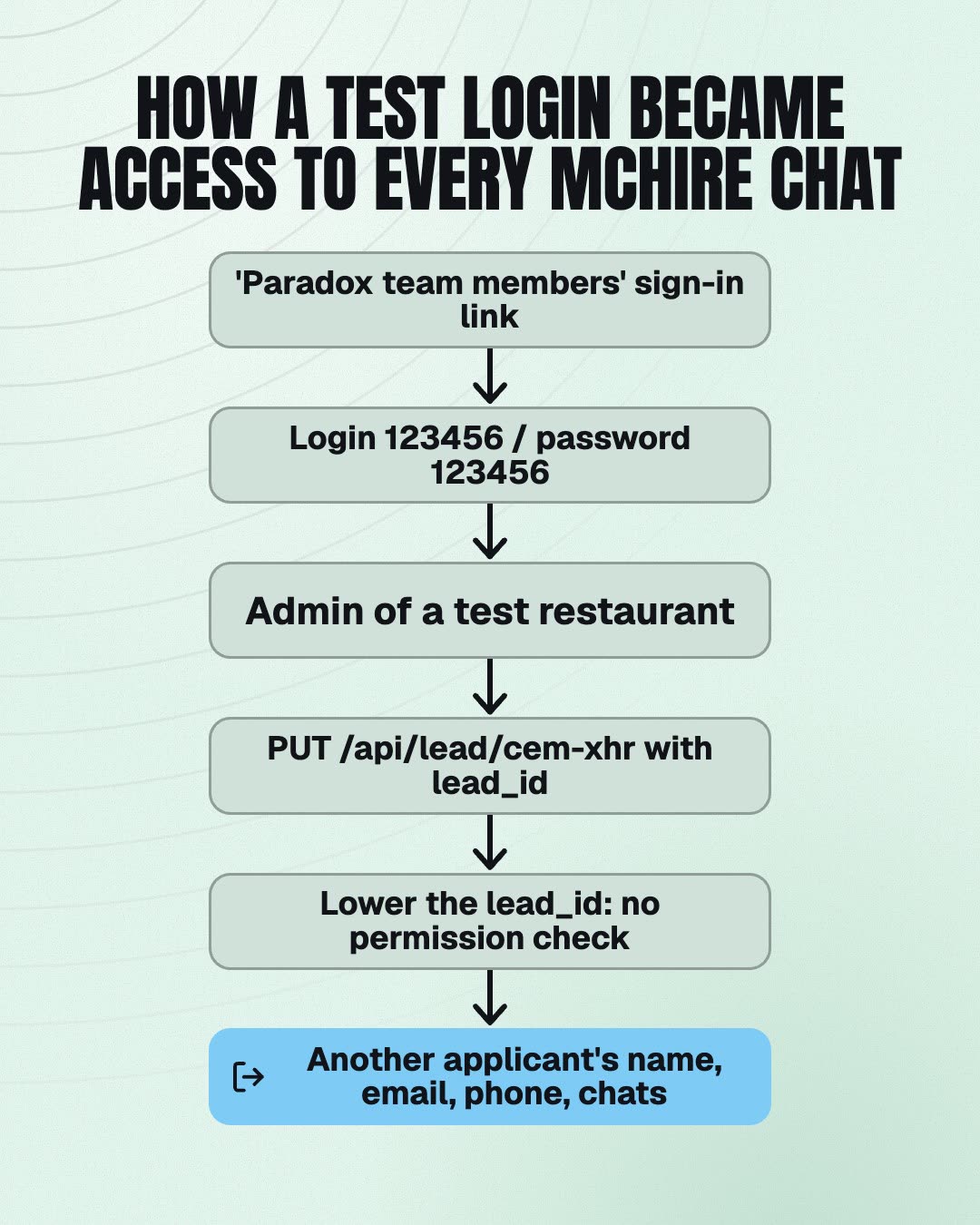
- A side door. The sign-in page tried to force McDonald's SSO, but a smaller link for "Paradox team members" accepted 123456:123456. The researchers became admins of a test restaurant whose staff were all Paradox employees.
- A request with a number in it. They applied to one of the test job postings and watched the restaurant side. A request, PUT /api/lead/cem-xhr, fetched candidate info by a lead_id. Theirs was about 64,185,742.
- A missing check. When they lowered that number, the API returned another real applicant's data, with the contact details unmasked.
That third step is an IDOR, an insecure direct object reference. The app hands out record numbers and never checks whether the logged-in user is allowed to see that record. OWASP lists this as the top API security risk. Its rule is simple: every endpoint that receives an object ID should check that the user may act on that object.
What came back: name, email, phone, address, the state of the application, every form input, and an auth token that could log in as the applicant and show their raw chat messages.
64 million or five? Two accounts of the same bug
The researchers say the two flaws together let anyone with a McHire account reach the personal data of "more than 64 million applicants". BleepingComputer later changed its headline: these were 64 million applications, not unique people. Paradox told it a record could be any chatbot interaction, even a button click with no personal data.
Paradox gave its side in a July 9 blog post:
- The test account hadn't been logged into since 2019 and "should have been decommissioned".
- Password standards were raised over the years, but this account's password was never updated.
- The researchers pulled seven chat records. Five belonged to US candidates and included names, emails, phone numbers and IP addresses.
- Only one client organization was affected, and no Social Security numbers were exposed.
- "None of our penetration tests previously identified the issue."
We take responsibility for this issue. Full stop.
Paradox.ai, Responsible Security Update
McDonald's told Wired it was "disappointed by this unacceptable vulnerability from a third-party provider" and said the issue was resolved the same day it was reported.
Both sides are describing the same bug. 64 million is the reachable scope the researchers estimated. Five is the number of applicants Paradox says actually had their data viewed, and only by the researchers.
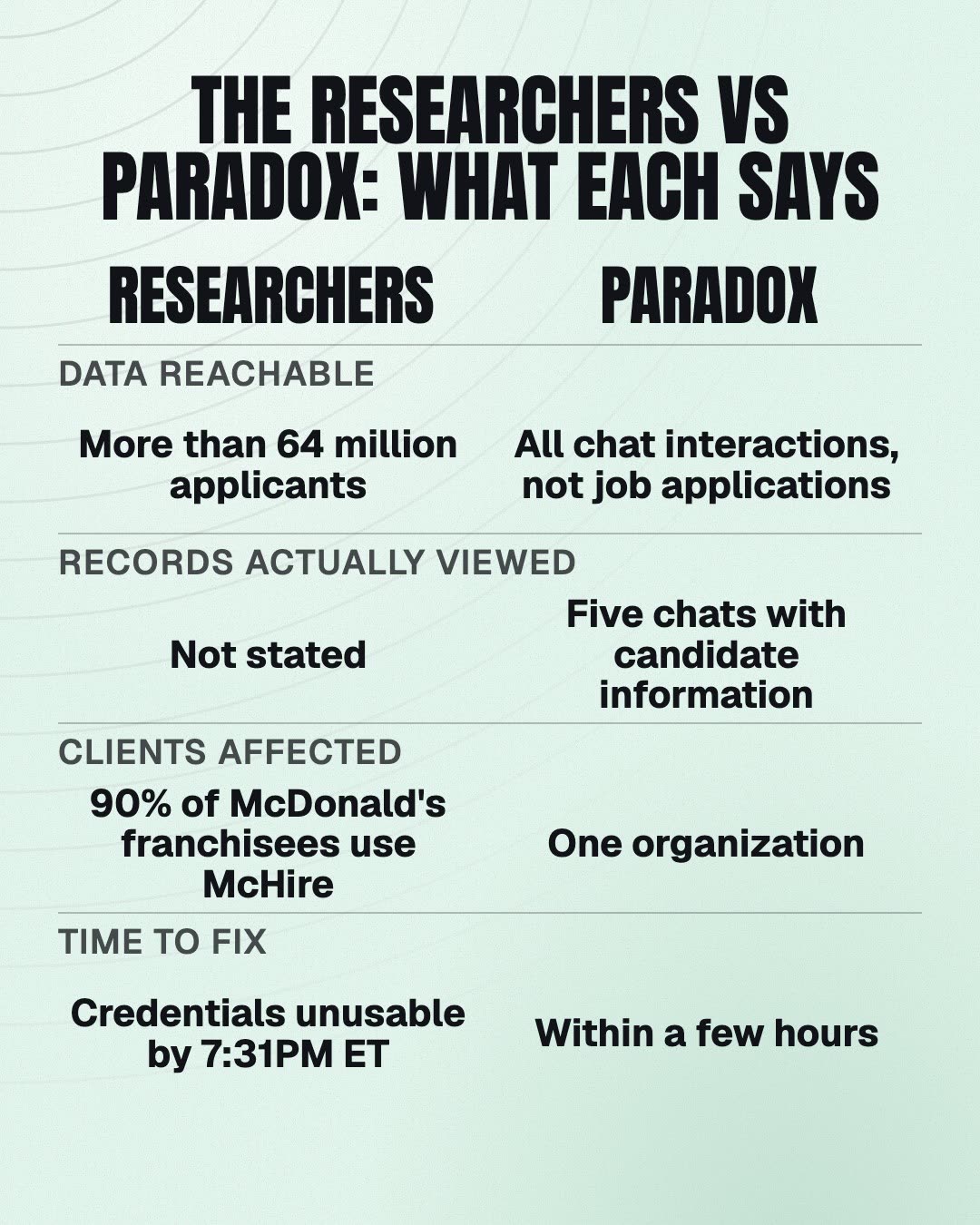
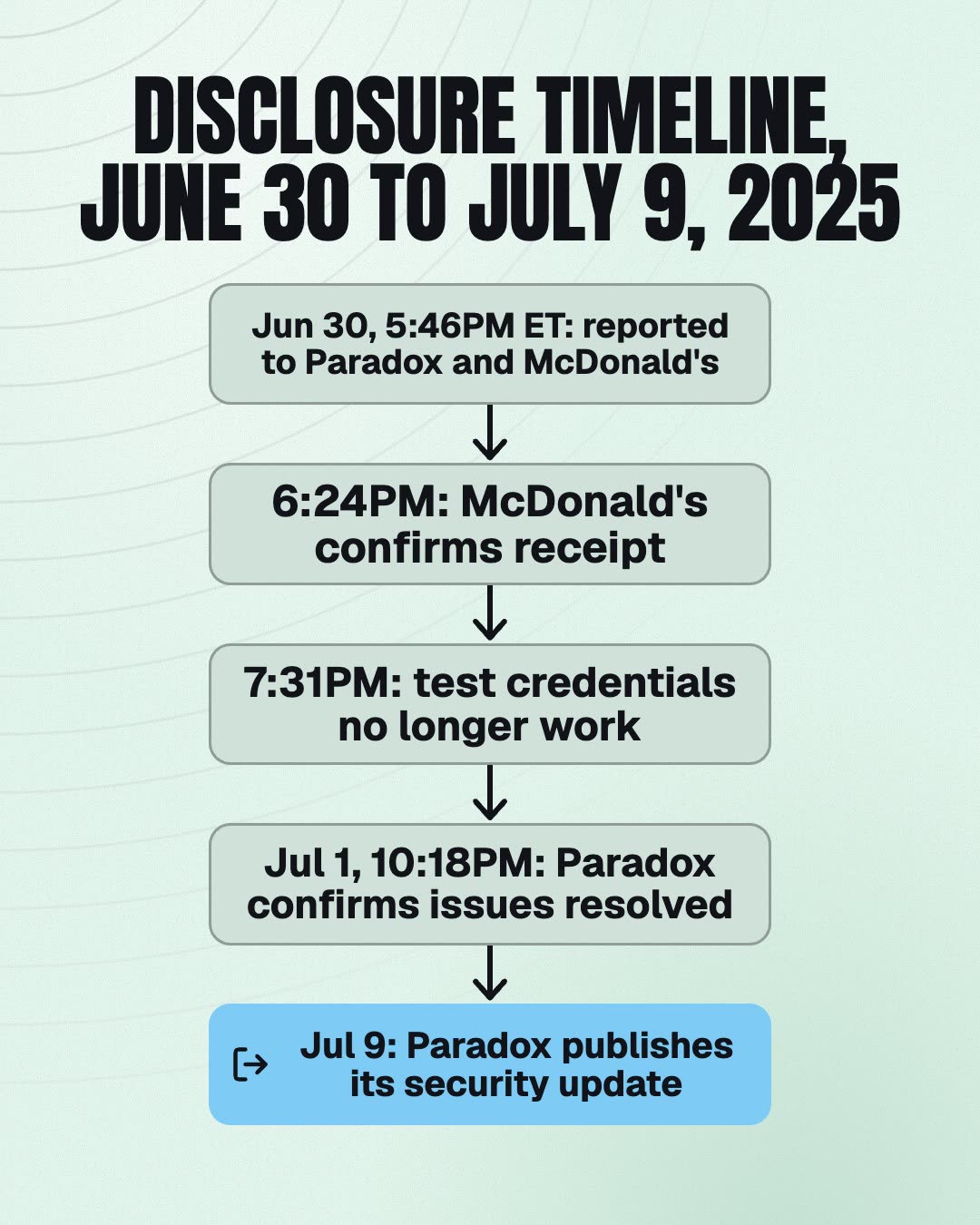
The fix itself was fast. Per Carroll's timeline, the issue was disclosed at 5:46 PM ET on June 30. McDonald's replied at 6:24 PM, the credentials stopped working at 7:31 PM, and Paradox confirmed both issues resolved at 10:18 PM ET on July 1.
Reporting it was the awkward part. The researchers found no public security contact and "had to resort to emailing random people." Paradox has since added security@paradox.ai and announced a bug bounty. Our read: a good response, weak preparation.
The part that missed the headlines: vendor staff and old certificates
KrebsOnSecurity dug further. At the end of June 2025, malware called Nexus Stealer infected the device of a Paradox administrator in Vietnam. It stole usernames and passwords for internal and third-party services.
According to Krebs, those stolen credentials show the developer once used the same seven-digit password for Paradox accounts of several Fortune 500 customers. Paradox confirmed the infection. It said few of the passwords were still valid, and that it has required SSO with multi-factor authentication for partners since 2020.
Paradox announced ISO 27001 and SOC 2 Type II audits back in February 2019. Krebs asked how a 123456 account survived them. Paradox's answer: at the time, its contractors weren't held to the same security standards as the company itself.
Here's why it matters for buyers. A certificate is a snapshot of one moment. Your data is only as safe as the vendor's weakest test account, contractor laptop and forgotten login. That's why the questions below ask about practice, not badges.
Why AI chat tools hold more of your data than a form
A web form collects the fields you designed. A chatbot keeps the whole conversation: free text, follow-ups and everything people volunteer along the way.
McHire held more than that. It stored shift availability, personality test results (the test was powered by Traitify), every change in the state of an application, and session tokens that could open a candidate's chat.
AI vendors also run many clients on one platform. That's why Paradox stressed that only one client instance was affected. When isolation between clients is weak, one flaw can reach well beyond one customer.
For a small team, the lesson is simple. Plug in a chatbot for hiring, support or patient intake and you hand a vendor a bigger, more personal dataset than your old web form ever held. Vet the vendor as if it were your own database, because it is.
10 questions to send any AI vendor before you sign
Copy these into an email. Each one maps to a real failure above. A good vendor can answer them in writing within a few days.
- Test, demo and old accounts: how do you keep track of them, and when did you last remove unused ones from production? (The 2019 test account.)
- Default and shared passwords: are they banned everywhere, including staff and support logins? (123456:123456. CISA urges software makers to get rid of default passwords.)
- MFA and SSO: is every admin login, including your own staff's side door, behind SSO with MFA? Can we enforce our own SSO? (The "Paradox team members" link.)
- Access checks: does every API that takes a record ID check that the user may see that record, and do automated tests cover it? (The lead_id IDOR. OWASP advises writing tests for authorization and not deploying changes that fail them.)
- Pen tests: when was the last external test, who ran it, did it cover admin and staff paths, and can we see a summary? (Paradox's tests missed this.)
- Disclosure: do you publish a security contact and a vulnerability disclosure policy or bug bounty? (The researchers had to email random people.)
- Data and retention: what exactly do you store from chats (transcripts, test results, tokens), for how long, and how do we delete it?
- Client isolation: can a login in one client's account ever reach another client's data? How do you test that?
- People and devices: are employees and contractors held to the same security rules, and what happens when credentials are stolen? (The infostealer findings and the 2019 contractor gap.)
- Logs and notice: can you show who viewed which records, and how fast will you notify us of an incident, written into the contract? (Paradox could say five records were viewed only because it could check.)
Treat certifications as a starting point, not an answer. Ask for the audit date and scope, then ask the questions anyway.
What we'd do this week, and the limits of a checklist
Then check your own side of those accounts:
- Turn on SSO and MFA wherever the vendor offers them.
- Remove old test users and former staff.
- Set a retention period for chat logs instead of keeping everything forever.
A checklist has limits. A vendor can answer every question well and still have a forgotten account somewhere. Answers don't replace contract terms on notification time, deletion and audit rights. For high-risk data, they don't replace a quick independent review either.
There's also an open question. Chat-based tools keep growing what they collect. Before asking how a vendor protects full transcripts, it's fair to ask whether you need them stored at all.
McHire wasn't brought down by an exotic attack. It was two basic gaps that ten plain questions would have flagged. If you're building AI workflows that handle sensitive data and want a second pair of builder eyes on the vendor or the setup, work with us.