
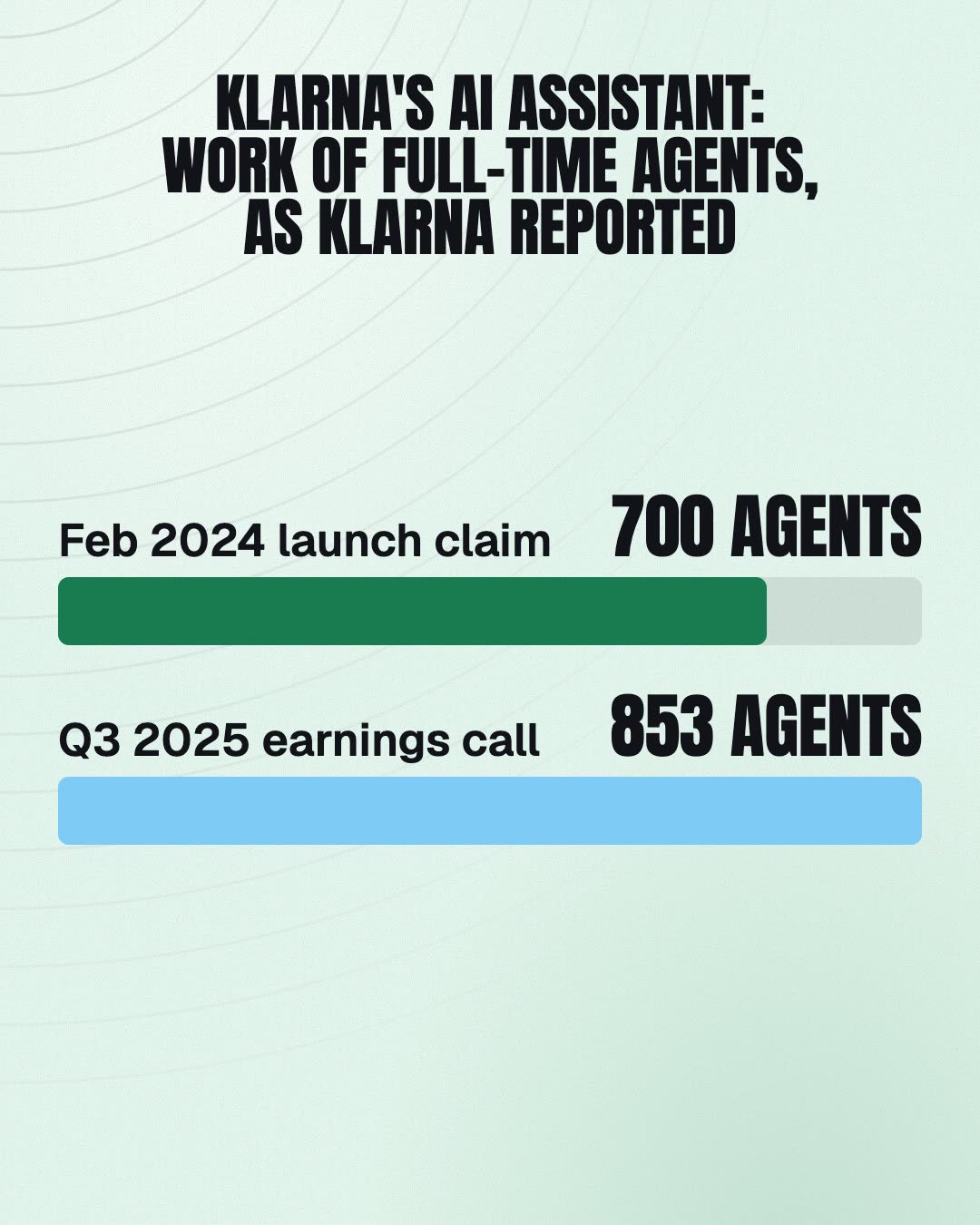
In February 2024 Klarna said its AI assistant was doing the work of 700 full-time agents. In May 2025 its CEO said cost-cutting had gone too far, and Klarna started hiring people for support again. Both statements are true, and the gap between them is the most useful lesson we know about putting AI on support.
Founders keep asking the same question: does AI support actually cut headcount, or does it just move the problem around? Below we go through what Klarna said publicly, what vendors report as resolution rates, how pricing works, and what we'd do on a small team.
The number everyone quotes: 700 agents in one month
On February 27, 2024, Klarna announced that its OpenAI-powered assistant had 2.3 million conversations in its first month. That was two-thirds of all its customer service chats. Here's the rest of what Klarna claimed:
- The equivalent work of 700 full-time agents.
- Customer satisfaction on par with human agents.
- A 25% drop in repeat inquiries, because errands were resolved more accurately.
- Errands solved in under 2 minutes instead of 11.
- An estimated $40 million profit improvement in 2024.
One line in the press release gets skipped a lot: customers could still choose to talk to a live agent if they preferred. Keep that in mind. It becomes the whole story later.
The announcement also sent shares in call-centre provider Teleperformance spiralling. That's a big part of why this became the case everyone cites.
May 2025: "cost was a too predominant evaluation factor"
Fifteen months later, co-founder and CEO Sebastian Siemiatkowski told Bloomberg that the cost focus had gone too far:
As cost unfortunately seems to have been a too predominant evaluation factor when organising this, what you end up having is lower quality.
Sebastian Siemiatkowski, Klarna CEO, to Bloomberg
Klarna started recruiting human agents again so customers would always have the option of a real person. In his words: "there will be always a human if you want." The new model is an "Uber type of setup": agents who can log in and work remotely. Klarna is aiming for candidates such as students and rural populations. The pilot started with two agents, and the goal is to eventually replace the few thousand agents Klarna outsources.
Some context: Klarna had paused hiring for over a year, and headcount fell 22% to 3,500, mostly through attrition (Entrepreneur). There had been an early warning, too. Back in 2024, Gergely Orosz of The Pragmatic Engineer tested the bot and wrote that it acted "basically as a filter" to reach human agents.
It wasn't a retreat from AI. Read the later numbers
If Klarna had given up on AI, the numbers would have dropped. They went up. On the Q3 2025 earnings call, Siemiatkowski said the AI agent does the work of more than 853 full-time agents, up from 700, and has saved $60 million (CX Dive). Klarna said there was "no drop in consumer satisfaction" in its Q1 2025 report, and later called satisfaction "on-par" with human agents.
Not everyone agrees. Forrester analyst Kate Leggett called Klarna "almost the poster child for bad AI deployment." She said customers complained about generic answers to nuanced questions, and that people with institutional knowledge were let go. One more detail worth noticing: even with the $60 million in savings, customer service and operations cost $50 million in Q3 2025, up from $42 million a year earlier.
In February 2026 Siemiatkowski described the split like this (CX Dive): AI is "the cheap customer service" for easy questions like "Hey, did I pay Klarna?", and "the future of VIP experience will be the human connection." He says satisfaction with Klarna-hired agents is "through the roof." He also said nobody in support was laid off: Klarna stopped using outsourced agents, and those people moved to other work at their vendors. That's his statement, and we haven't seen it independently verified.
Vendor resolution rates: 76%, "good is 30–50%" and 38% in a small test
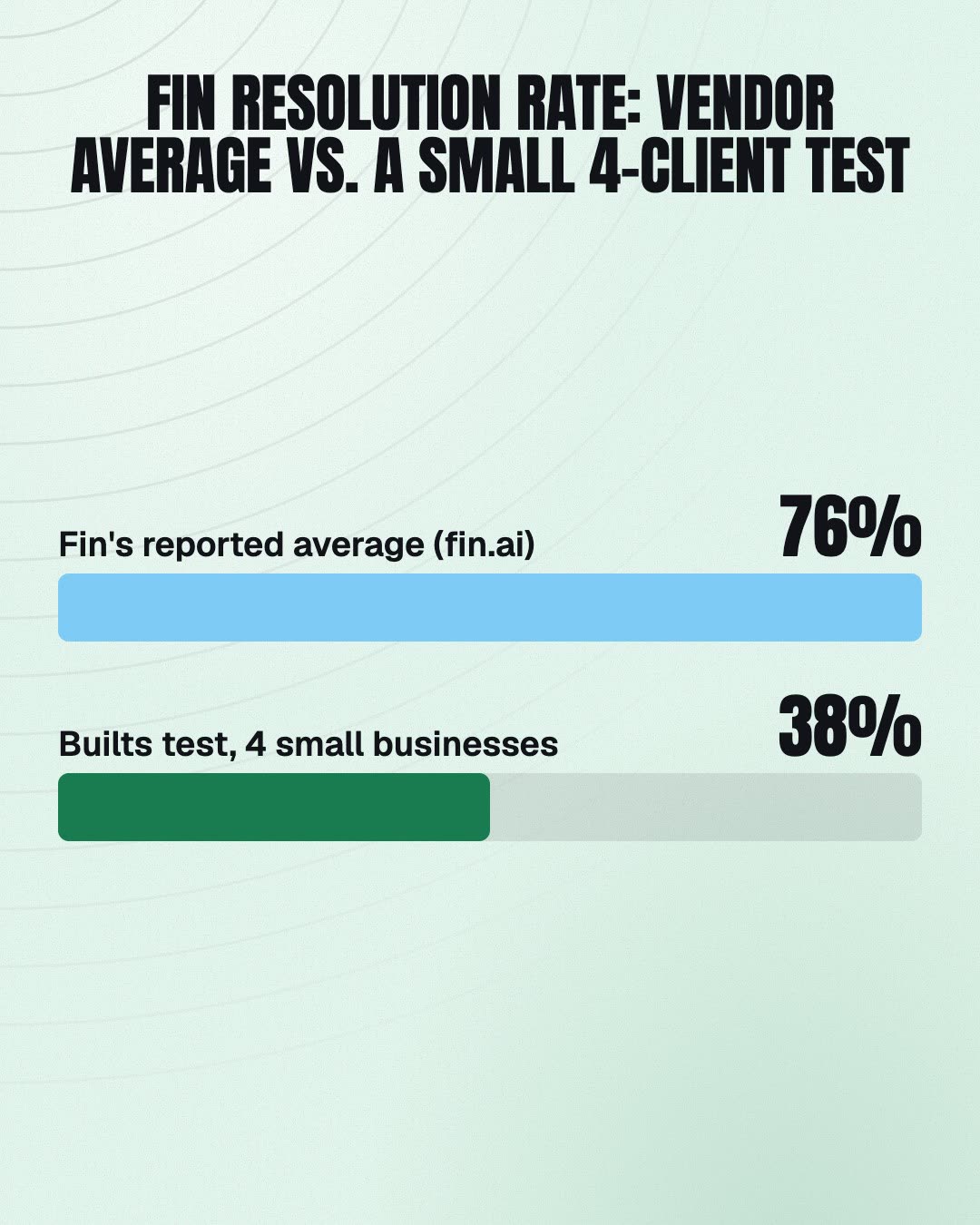
Most teams won't build their own bot like Klarna. They'll buy one, so the number to understand is the vendor's resolution rate. Fin (formerly Intercom) says its AI agent has a 76% average resolution rate across more than 12,000 customers. The fine print: the rate is calculated only across conversations where Fin was involved.
How a resolution gets counted matters just as much. Per an Intercom support engineer on the community forum, it counts if the customer clicks "that helped" or doesn't reply and leaves without asking more. So silence counts as success. In the same thread, the engineer said there is no one right percentage, and that "a good resolution rate starts at around 30-50%", depending on setup, volume and help-centre quality.
Here's an outside data point. Builts deployed Fin for four small business clients handling about 500 tickets a month, over 60 days. Their average was 38%, at about $1.40 per resolved ticket all-in. Fin was worth it for 2 of the 4.
To be fair to both sides: this is one small, uncontrolled test, and Builts sells AI services itself. Don't read 76% vs 38% as one number beating the other. What it shows is how much the definition, the denominator and the quality of your help-centre docs decide the result.
- What counts as resolved? A confirmed answer, or just silence?
- Which conversations are in the denominator? All of them, or only the ones the AI touched?
- What happens to reopened tickets? Do they stop counting as resolved?
What the pricing tells you about the trade-off
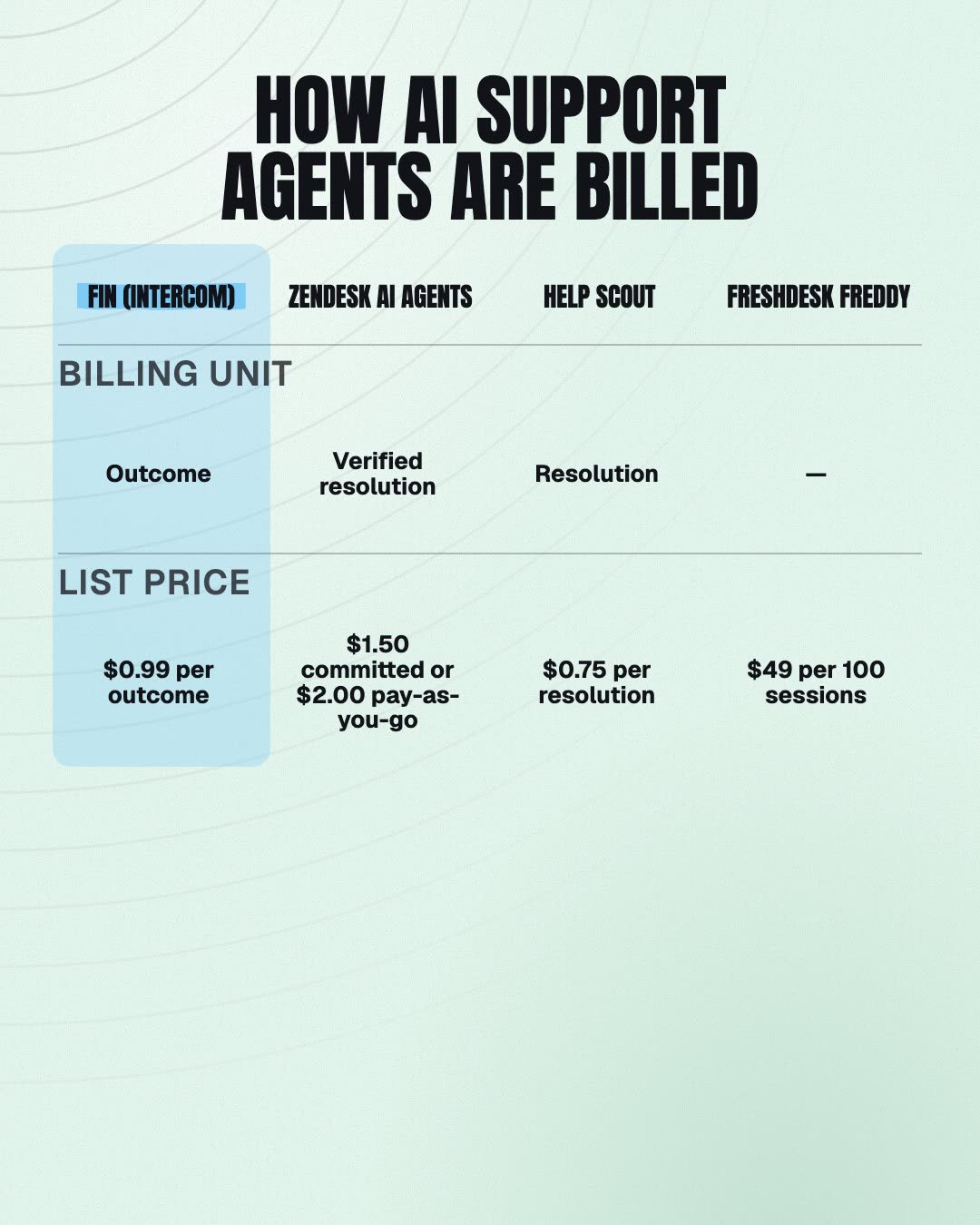
Fin charges $0.99 per outcome, at most once per conversation (Gleap's pricing breakdown). An outcome means one of three things: the customer confirms the issue is resolved, the customer doesn't ask for more help after Fin answers, or Fin completes a workflow, including a handoff you set up. A reopened conversation refunds the outcome. If the customer asks for a human at any point, you don't pay.
Seats come on top: $29, $85 or $132 per seat a month, billed annually. Other vendors bill in different units, so unit prices don't compare directly:
- Zendesk: per verified resolution, with an allowance per agent seat, then $1.50 committed or $2.00 pay-as-you-go.
- Help Scout: $0.75 per resolution.
- Freshdesk: $49 per 100 sessions after 500 free ones.
Builts' math is a good sanity check. If a ticket takes a person 8 minutes at $25 an hour, that's $3.33 in labour, so $0.99 is a good trade, but only when the AI actually closes the ticket. A "resolution" that comes back as a repeat contact costs you twice.
One more thing: Salesforce completed its acquisition of Fin on September 10, 2026. Pricing and packaging can change after a deal like that, so check the current page before you sign a long contract.
A small-team plan: automate first, keep human, measure
Klarna's story and Forrester's critique actually agree on one point. As Leggett put it, "the simple inquires will get fully automated. The more nuanced questions will fall to your human customer service workers." Here's how we'd act on that:
- First, tag your tickets. Pull three to six months of conversations and mark the repetitive ones that your docs can answer: order status, "did my payment go through", how-to questions, policy questions.
- Next, fix the help centre. Intercom's own support team and the Builts test both say documentation quality shapes the resolution rate. Rewrite the articles behind your top questions before launch, not after.
- Then decide what stays human. That means refunds and disputes that need judgment, angry or at-risk customers, and anything nuanced or high-value. Make "talk to a person" one click away, like Klarna now promises.
- Finally, measure weekly. Track true resolution (confirmed, not silence), repeat contacts within 7 days, CSAT for AI and human conversations separately, and all-in cost per resolved ticket.
Limits, open questions and what we'd do
Most of these numbers come from the companies themselves. Klarna's 853 agents and $60 million are its own claims. Fin's 76% is its own average. The independent test covers four businesses. We still don't have a public, like-for-like comparison of AI and human support quality at any of these companies. And customer service at Klarna cost more in Q3 2025 than a year earlier, which savings headlines don't explain.
Our rule is simple: if repeat contacts rise or CSAT drops on a topic, move that topic back to people, even if the cost looks good. That's exactly the trap Klarna's CEO named. AI can take most of the easy volume. Keeping a person one click away is what protects the rest.
Want help mapping your tickets and building the routing between AI and your team? We build these workflows. Work with us.